
How to Become an F1 Driver
With just 20 seats across 10 teams, the path is crowded. You need talent, years of training, big financial support, and, to be honest, some luck.
Most drivers start as kids and spend a decade or more working through junior series, proving themselves at every step.
What Does It Mean to Become an F1 Driver?
Being an F1 driver means joining an elite group of athletes who mix raw speed with strong technical knowledge. It means being among the best drivers on earth, handling very advanced cars at extreme speeds under heavy pressure.
Formula 1 is the highest level of motor racing. It's a fast, high-tech arena where speed, engineering, and driver skill draw in millions of fans.
The job is more than driving fast. It includes a wide set of duties that require physical, mental, and technical strength, plus an understanding of the business side of the sport. It is a life of constant training, travel, and public attention, where every choice on and off the track can matter a lot.
What Are the Core Responsibilities of an F1 Driver?
F1 drivers have many duties. They must get the most from a very advanced race car and push limits while staying in control. They need racecraft (overtaking, defending, tire use) and a strong grasp of setup, aerodynamics, and the power unit.
Drivers work with engineers in an ongoing cycle of design, build, test, and improve. Their job also extends outside the car.
Drive at the limit while managing tires, fuel, and strategy.
Give clear, useful feedback to engineers to improve the car.
Handle media work, sponsor events, and public appearances.
Cope with pressure and make instant decisions at high speed.
Keep top fitness to handle G-forces, heat, and long races.
In short, an F1 driver mixes the skills of an athlete, a technical voice in the team, and a public figure.
What Is the Typical Pathway to Formula 1?
The usual path to F1 is a long climb up a clear ladder of series. It often starts very young and calls for years of effort, sacrifice, and steady results in faster and tougher single-seater cars.
There are no shortcuts, only hard work and proof on track.
Most journeys follow three main stages:
Start young in karting.
Move into junior single-seater series.
Prove yourself in the main feeder categories just below F1.
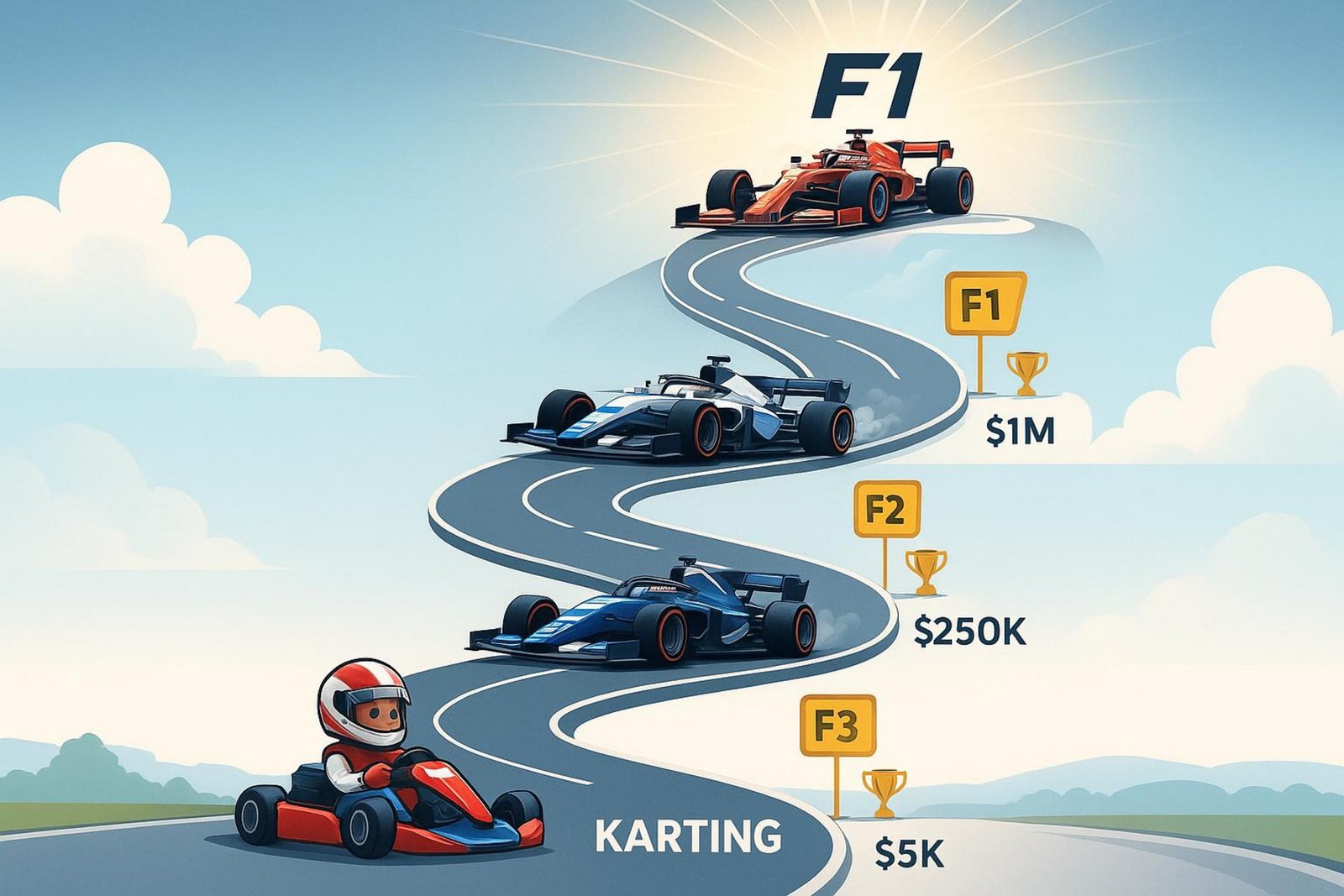
Starting Young: Karting and Early Motorsport Involvement
Almost every F1 driver begins in karting. This is where future stars learn racing basics. Many greats, like Max Verstappen, Charles Leclerc, and Lewis Hamilton, started at 6 or 7 years old, some even earlier. Karting clubs exist worldwide, making it a common entry point.
Karting is serious training. As Marco Zipoli, a professional driver focused on training at the Wave Professional Training Center, says, the kart track is like a “gym” for core driving skills. Drivers learn precise cornering, smooth acceleration and braking, and how a light, agile vehicle behaves.
They also build racecraft: planning passes, reacting under pressure, and handling tight racing. This early stage creates a strong feel for the car and teaches how to get the most from it.
Karting has clear rules and global events and serves as the main launchpad for higher levels.
Competing in Junior Racing Categories
After karting, drivers move into junior single-seaters. These are the first steps in faster, more advanced cars.
Common routes include Formula 4 (F4), Formula Regional, Formula 3 (F3), and Formula 2 (F2). Each level brings more speed, more tech, and tougher rivals.
These series give young drivers the track time and exposure they need. The racing is very hard, and many strong drivers fight for the same goal: to move up the ladder.
Good results again and again matter, as F1 teams and scouts watch closely. The F1 Academy, a female-only category, also has a big role in growing female talent and offers a route with FIA points similar to F4.
Progressing Through the Racing Ladder: F4, F3, F2
Most drivers follow a clear path. After strong results in karting, they enter an FIA Formula 4 championship, then move to Formula Regional (such as Formula Regional Americas), then FIA Formula 3, and finally FIA Formula 2. These are the main feeder series to F1.
F4: first step in a single-seater race car.
Formula Regional: faster cars, stronger field.
FIA F3: large grids and heavy competition.
FIA F2: direct step below F1.
Each category presents more challenges. Cars are much faster, the tech load grows, and the field is stacked. To catch F1 team interest, drivers must do more than compete-they must keep winning races and titles.
As they move up, their rivals are also the best from lower levels, so only the most consistent front-runners keep climbing toward F1.
How Do Driver Academies and Sponsorships Help?
Racing is very expensive and the fight is tough, so academies and sponsors often make the difference. Running a season in junior series can cost a lot.
F1 team academies (like Mercedes, Ferrari, and Red Bull) test young talent and offer coaching, funding, and big resources. Joining an academy is often the best route to a seat because it gives a clear plan and direct access to F1 people. Many current stars came through these programs.
If you are not in an academy, personal sponsors are key. Drivers must attract funding with strong results and a good public image. In some cases, money can outweigh raw talent when a team chooses a driver.
What Qualifications Are Required for F1?
Beyond talent and years of racing, F1 has strict rules on who can race. The key requirement is the FIA Super Licence, issued by the sport’s global body, the Fédération Internationale de l’Automobile (FIA). Without it, a driver cannot race in F1.
The Super Licence rules are strict to keep F1 safe and fair. They set limits based on age, results in feeder series, knowledge of F1 rules, and a points system based on your finishing positions in approved championships.
What Is the FIA Super Licence?
The FIA Super Licence is the top licence for single-seater racing. The FIA issues many licences, from karting to endurance racing, but an F1 driver needs the Super Licence. The rules live in the International Sporting Code, which covers FIA events.
The Super Licence is more than a formality. It is proof that a driver has the skill, experience, and rule knowledge needed to race safely at the highest speed level.
How Are Super Licence Points Earned?
A key rule is earning at least 40 Super Licence points over a set period. Points come from results in FIA-approved series. The FIA counts either the three years before the application year, or the two years before plus the application year.
Different series award different points. A title in FIA Formula 2 or IndyCar gives 40 points, which is enough by itself. Other strong series like FIA Formula 3, Formula E, and Japanese Super Formula award 30 points for a title. National F4 series give fewer points, often 12 for a title.
You can also earn extra points, such as:
2 points for finishing an entire FIA season with no penalty points
1 point per F1 Free Practice session (up to 10) if you have a Free Practice only Super Licence and complete at least 100 km with no penalties
Example: Logan Sargeant reached the needed total for 2023 by combining strong F2 results with F1 practice mileage and bonus points for clean driving.
Series (Champion) | Points |
FIA Formula 2 | 40 |
IndyCar | 40 |
FIA Formula 3 | 30 |
Formula E | 30 |
Japanese Super Formula | 30 |
National FIA Formula 4 | 12 |
Are There Age or Experience Requirements?
In the past, the minimum age was 18 at the first F1 race. Drivers also needed an FIA International Grade A licence and a road-driving licence.
In 2024, the road-driving licence rule was dropped. The FIA also added that it can choose to give a Super Licence at 17 to a driver who shows outstanding ability and maturity in single-seater racing.
This change drew attention during talk around Kimi Antonelli, set to join Mercedes in 2025, who received his Super Licence at 17. Max Verstappen also started F1 at 17 in 2014.
Beyond age, drivers must have completed at least 80% of two separate seasons in approved single-seater series and pass a test on the International Sporting Code and F1 Sporting Regulations.
For drivers coming back to F1, the rules include recent single-seater results and a 300 km test in a current or recent F1 car within 180 days of applying.
Which Skills and Attributes Are Needed to Succeed?
Success in F1 calls for a rare mix of natural talent and carefully built skills. It is not just about raw speed; it is about being great in many areas, in and out of the car. The demands are among the highest in pro sports.
Key areas include:
technical driving skills and racecraft
physical fitness and mental strength
teamwork, communication, and media skills
financial backing and connections
Technical Driving Skills and Racecraft
Top-level car control sits at the core of F1 success. Drivers need a strong feel for vehicle dynamics, hit apexes lap after lap, manage tire wear, and find the limit in all conditions. They must adjust steering, throttle, and brakes in an instant, often at over 200 mph.
Racecraft is just as important. Drivers plan passes, defend well, manage fuel and energy, and handle tricky race situations under pressure. They read the race, judge rivals, and make smart choices that save time and avoid mistakes.
This skill grows through years of racing, starting in karts and building through each step.
Physical Fitness and Mental Preparation
F1 drivers are among the fittest athletes. Braking, accelerating, and cornering put heavy G-forces on the body. Strong arms and neck are needed to handle the wheel and the forces, and hand-eye coordination must be sharp. Drivers can lose a lot of fluids in hot races, so endurance and hydration matter.
Mental training is very important, too. F1 brings heavy pressure. Drivers must stay focused for long periods, make split-second calls, and stay calm.
Simulator work helps build focus and confidence by letting drivers face tough situations in a safe setting. The best drivers keep their level lap after lap, even at the limit.
Teamwork, Communication, and Media Skills
F1 drivers are part of large teams. Good teamwork and clear communication are very important. Drivers need to give clean, precise feedback about grip, balance, and any issues. This helps the team get the best setup and plan race tactics.
Simulators help drivers and engineers test ideas and pick better strategies together.
Drivers are also public figures. They meet the press, attend events, and connect with fans. A strong media game helps bring and keep sponsors, which supports a racing career. Being able to explain technical topics, handle interviews, and represent the team well is part of the job.
Financial Backing and Sponsorship Connections
Talent alone often is not enough. Strong funding and sponsor links are common needs. Even basic karting can cost more than £10,000 a year. By the time a driver reaches F2, a season can cost millions.
Many F1 drivers have access to funding at home to pay for junior series. Others must find sponsors. That takes results on track and a clean, engaging image off it. While there are exceptions, money can sometimes weigh more than pure pace when a team makes a choice, leading to “pay driver” situations.
How to Train for an F1 Career
The path to F1 is long, and training never really stops. It involves time on track, advanced tools, expert help, and hard physical and mental work. Drivers chase small gains all the time.
From early karting to the final steps before F1, training gets more focused. Common parts include modern simulators, expert coaching, and team-led programs.
Role of Professional Driving Simulators
Professional simulators are a very useful training tool. They bring together theory and real track skills by closely copying how F1 cars behave on many circuits, with strong feedback and motion.
Simulators let drivers train without the very high cost and risk of track testing. They help build feel for the car, improve corner exit power use, and sharpen braking. They also build mental strength by placing drivers in pressure moments that demand quick choices.
Sim work also tightens teamwork with engineers, who can try setups and strategies. Companies like Wave Italy offer advanced simulators, such as the Ghepard Maranello and Phoenix Pro, with single-seater cockpits and pro-grade hardware to help both young and experienced drivers improve.
Importance of Expert Coaching and Racing Schools
Expert coaches and strong racing schools are key parts of an F1 training plan. From the start in karting, good coaches teach racecraft, car control, and smart race choices. They help drivers build good habits and fix bad ones early.
Racing schools offer structured programs, which help older beginners or those who want to speed up learning. These schools provide different cars, from entry-level formula cars to real F1 machines, so drivers can learn basics and advanced skills safely.
Picking a school approved by the licence body is a smart move, as they may provide letters that help with licence steps. Learning from pros speeds up understanding of driving technique and race car physics.
Participating in Test Days and Simulator Programs
As drivers climb the ranks, official test days and high-level simulator programs become very important. Test days give track time in junior formula cars to try setups and gain experience under real pressure. These sessions help polish racecraft and show how setup changes affect the car.
Many F1 teams run simulator programs for academy drivers and prospects. These give long hours in advanced sims, track learning, and direct work with engineers. This time helps drivers learn F1 car systems and give accurate feedback.
The 300 km run in a recent F1 car for the Super Licence-often done in official tests-also shows why this high-level practice matters.
Common Challenges and How to Overcome Them
The road to F1 is full of tough challenges. It tests a driver’s skill, mindset, and resources. Knowing the main hurdles and planning how to deal with them matters as much as pace on track.
Costs are high, rivals are many, and setbacks will happen. Success often depends on skill on track and smart moves off it, while working through the busy system of pro motorsport.
1. Financial Hurdles and Securing Sponsorship
Money is a big, common barrier. Racing costs can reach tens of thousands in karting and millions in junior series. This blocks many talented drivers before they can show what they can do. For most, strong sponsorship is the only path ahead.
To push through, many drivers take an active and business-minded approach. They build proposals, network with investors, and grow a personal brand that sponsors like. Results help most, but a clear public image, good speaking skills, and a willingness to appear at events also matter. Many drivers spend as much time finding funds as they do driving.
2. Standing Out Among Talented Competitors
With millions chasing only 20 seats, the fight is extreme. Each step up means facing a tighter group of very strong racers. To stand out, drivers need consistent results, raw speed, and big performances when it counts most.
Helpful traits include a strong work ethic, a careful approach to data and feedback, and a constant push to improve. Showing smarts, racecraft, and the ability to adapt to cars and tracks helps.
A clear driving style and strong personality can also catch the eye of scouts and team bosses in a sea of talent.
3. Dealing With Setbacks and Staying Motivated
The path to F1 is rarely smooth. Crashes, car problems, money gaps, and missed chances are common. Handling these issues and staying driven is part of the job.
Resilience matters. Drivers should review mistakes, take lessons, and move on without losing belief. Support from family and coaches can help a lot.
Keeping a long-term view, even after short-term misses, makes it easier to stay motivated. The ones who bounce back stronger often go the farthest in this very demanding field.
Final Thoughts on the Road to Formula 1
Formula 1 blends speed, tech, and human effort in a way that draws huge crowds. The dream of racing in it is strong, but the path is more like a narrow, winding road that few can climb.
The level of skill, the money needed, and the nonstop fight for seats mean that success takes talent, long-term effort, big sacrifices, and a bit of luck.
Frequently Asked Questions About Becoming an F1 Driver
Many people have questions about how to reach F1. Here are answers to common topics, including costs, age, and the early steps most drivers take.
How Much Does It Cost to Pursue an F1 Career?
The costs are huge. Karting alone can exceed £10,000 per year. A season in Formula 4 can run into hundreds of thousands. Formula 2 can reach millions. These costs cover the car, team fees, travel, lodging, equipment, and testing.
From karting to F1, total spending can reach many millions. That is why many drivers have strong financial support or backing from sponsors or manufacturer academies. Without steady funding, moving up through the ladder is very hard, no matter how talented you are.
What Is the Typical Age to Enter F1?
Most drivers debut in F1 in their late teens or early twenties. Many start karting at 6 or 7, and it can take 10 or more years to reach F1. This puts the usual debut age around 18-22.
Can You Become an F1 Driver Without Karting Experience?
It is not impossible in theory, but it is very unlikely. Karting is seen as the main first step for almost everyone who aims for F1. It teaches core skills, car control, racecraft, and pressure handling in a place that is fairly safe and cheaper than cars.