
What Is F1 Academy?
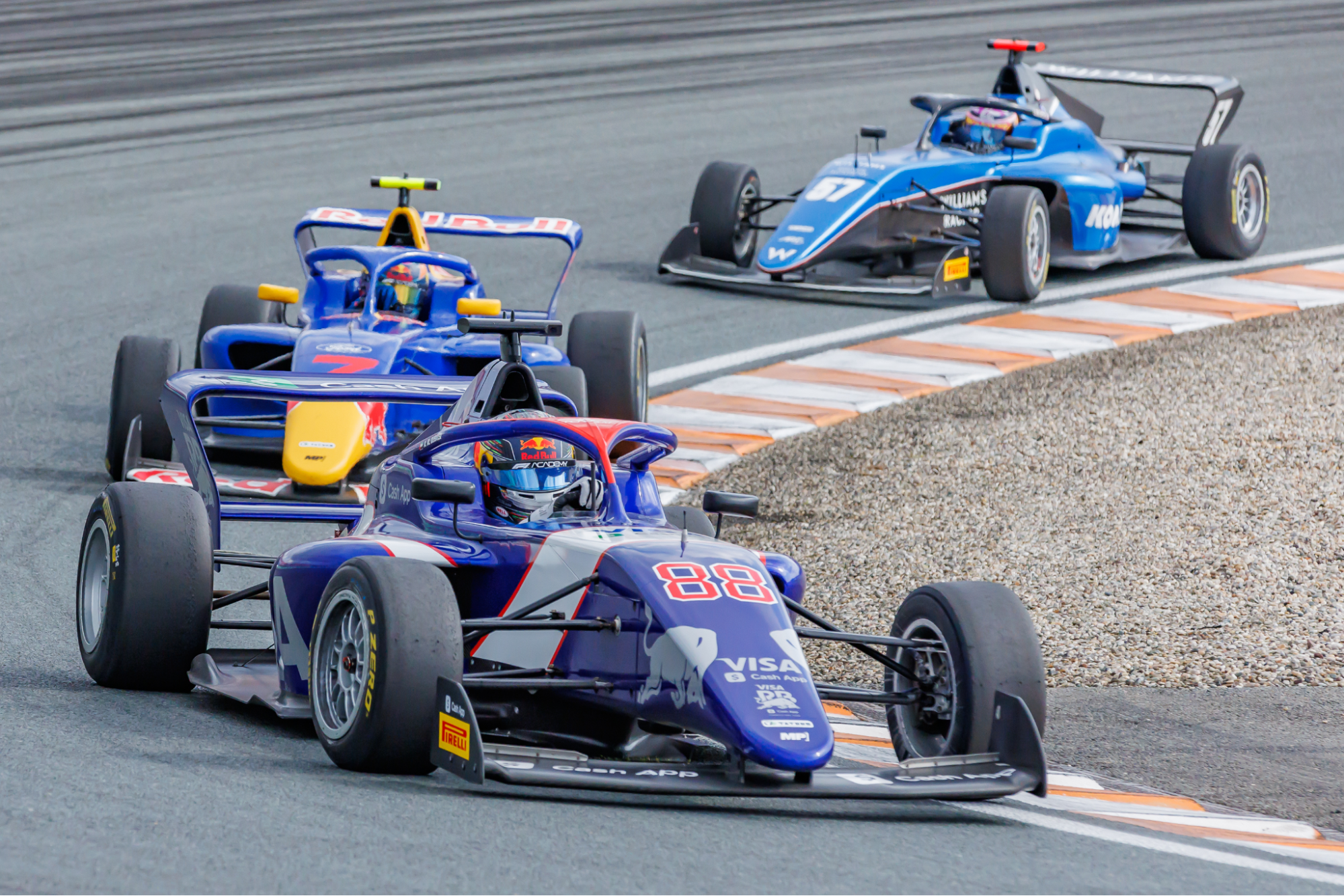
This women-only, Formula 4-level championship is an important stepping stone, focused on driver growth with full support on and off the track.
It is more than a racing series; F1 Academy is an all-round program that gives drivers the track time, coaching, and chances they need to grow in a very competitive sport. With structured testing, regular running, one-to-one mentoring, and fitness and mental training, the academy covers every area to prepare drivers for higher levels.
Its very purpose addresses a long-standing gap in motorsport, working to build a future where female drivers are strong contenders at the top of racing.
What Is F1 Academy?
At its core, F1 Academy is an international, female-only single-seater championship. It is an important step on the racing ladder, built to support and grow promising young female drivers. The series helps bridge the gap between karting and higher levels like Formula 3, Formula 2, and finally, Formula 1.
Launched in 2023, F1 Academy is a spec series. All teams use the same chassis, engine, and tyres, which puts the focus on driver skill. This creates a level playing field so talent can shine without big tech differences between teams.
The goal is clear: find and grow the best female drivers in the sport.
Why Was F1 Academy Created?
F1 Academy was created to tackle the lack of female representation in top-level racing. The path from grassroots to Formula 1 has long been harder for women, and many stop before reaching higher series.
Earlier efforts, such as Formula Woman in 2004 and the W Series in 2019, helped but faced challenges. The W Series ended after the 2022 season due to money issues.
On November 18, 2022, Formula One announced F1 Academy with a clear focus on driver development, not just racing. The series was built to smooth the move from karting to single-seaters, giving a structured, supportive place for female drivers to gain track time, sharpen their skills, and build mental strength for pro racing. It's a direct step to make sure female talent has a clear and well-supported route to the top of the sport.
Who Oversees F1 Academy?
F1 Academy is run by the Formula One Group, the same organization behind Formula 1. This link helps keep the series aligned with F1's wider goals and brings access to its knowledge, tools, and global reach. Susie Wolff was named managing director on March 1, 2023. She is a former racer and ex-Williams F1 test driver, bringing real-world experience and credibility.
Wolff's leadership shows F1 Academy's promise to provide a racing platform plus strong guidance and mentorship. All ten F1 teams back the series under a multi-year deal that started in 2024.
Each F1 team supports one F1 Academy driver, and that driver's car runs in the F1 team's livery. This ties the academy into the wider F1 system and gives key visibility and backing to the drivers.
Key Features That Set F1 Academy Apart
F1 Academy stands out with features that put driver growth and inclusion first. First, it is a spec series using the same Tatuus F4-T421 chassis, Autotecnica Motori engine, and Pirelli tyres. Success depends on the driver, not budget or tech advantages, so pure talent can shine.
Second, the series is closely linked with Formula 1. From 2024, all rounds run on select F1 weekends. This gives unmatched exposure and lets drivers race on the same tracks as F1 stars.
Also, all ten F1 teams must support one driver and run their livery, adding key funding and development help and a direct link to the top level. From 2024, the top five drivers also earn FIA Super Licence points, confirming F1 Academy as a real pathway to F1.

F1 Academy's Mission and Vision
F1 Academy's mission is clear: support the next wave of female racing talent and remove barriers on and off the track. The aim is a level playing field where skilled young women get the training, tools, and chances to climb into pro racing.
The vision goes beyond winning races; it focuses on building well-rounded athletes ready for the physical, mental, and technical demands of elite motorsport.
This mission is backed by a wider goal to build a sport that is more diverse, inclusive, and open to all. By focusing on female drivers, F1 Academy takes on a long-time imbalance and looks to inspire more girls and young women to enter a field mostly led by men. It shows that motorsport is for everyone and that talent has no gender.
How F1 Academy Promotes Diversity in Motorsport
Diversity sits at the core of F1 Academy. The series works to increase female participation as drivers and in many other roles across the industry. This broad approach shows in programs like F1 Academy Discover Your Drive, a global entry point that uses grassroots events and professional pathways to reach and inspire young women.
Discover Your Drive rests on three pillars: Community, Youth Engagement, and Talent Identification.
- Community builds a global network of people who want change, with events at races and outreach efforts.
- Youth Engagement shows girls they belong and can do well in motorsport.
- Talent Identification finds and supports promising drivers, removes barriers, and opens doors to off-track careers too.
Partnerships with groups like More than Equal are helping build a strong database for female driver development. Support for programs like the Champions of the Future Academy Programme Worldwide (COTFA) also boosts female entries in national and international karting.
Long-Term Goals for Driver Development
F1 Academy has long-term goals. The series is an important step that offers a structured place to build skills and gain key experience. Drivers get regular running, planned testing, and the chance to race on F1 weekends for extra learning and exposure.
Beyond driving, F1 Academy focuses on off-track growth too. Drivers get individual support and guidance, including mentoring with engineering feedback, plus fitness and mental training. The goal is to help these young women move up to series like Formula 3 and other Road to F1 categories.
Teams that sign top F1 Academy drivers get a guaranteed fourth entry in the Formula Regional European Championship (FRECA), and champions receive fully funded seats in higher series. These steps show a clear path upward.
Who Can Compete in F1 Academy?
F1 Academy is for female drivers aiming for the top levels of motorsport. The entry rules focus on young talent and a clear next step in their careers. The field is highly competitive but also very supportive, giving female racers a rare chance to show their skills on a global stage.
The selection process and the help from F1 teams highlight the push to grow talent and give the needed resources for the journey. The series seeks the best young female drivers from karting and junior formulas around the world and gives them a strong platform to move forward.
Eligibility Criteria for Drivers
Drivers must meet set rules to race in F1 Academy. The series is open to female drivers aged 16 to 25 at the start of the season. This range targets drivers at a key point in their growth, giving them valuable single-seater experience before moving up.
To keep fresh talent coming in, a driver cannot race in F1 Academy for more than two seasons. This keeps the series a step on the ladder, not a long-term stop.
From 2027, there may be an option for a third season for drivers who already completed two seasons if it helps their progress. This flexibility shows the series' focus on each driver's path.
From 2024, all ten F1 teams must support one F1 Academy driver, and that car carries the F1 team's livery. Other drivers, including wild cards added in 2024, are backed by series partners, widening the support network.
Pathways for Progression to Higher Racing Series
F1 Academy is built as a launchpad to higher series. It fills the space between karting and more advanced junior levels like Formula 3 and other Road to F1 steps. The series backs this goal with real opportunities for top performers.
For example, in FRECA, any team that signs a driver who finishes in the top three of the F1 Academy standings gets a guaranteed fourth entry. Champions also receive strong backing for their next move. Marta García, the 2023 champion, earned a fully funded seat in the 2024 FRECA Championship thanks to F1 Academy, Prema Racing, Tatuus, and Pirelli.
Abbi Pulling, the 2024 champion, secured a fully funded drive with Rodin Motorsport for the 2025 GB3 season. These cases show the academy's active support for its graduates as they climb the ladder.
How Does the F1 Academy Championship Work?
F1 Academy is set up to be competitive while still focused on development. The format changed after the first season in 2023 to boost driver exposure and better match the feel of an F1 weekend. Knowing the structure, race format, and points system helps explain the intensity and tactics in the series.
The races push drivers on speed, race craft, consistency, and mindset. Events run on famous tracks, often alongside F1 Grands Prix, giving drivers top-level pressure and experience.
Championship Structure and Race Format
In 2023, the season had seven event weekends with three races each. From 2024, the series runs only on select F1 weekends, joining other supports like Formula 2, Formula 3, and Porsche Supercup. To fit these events and raise exposure, weekends moved to two races, removing the 20-minute reverse-grid race used in 2023.
For 2025, the format changed again: Race 1 is now a reverse-grid race. This brings the format closer to Formula 2 and Formula 3 and adds more strategy. A typical weekend includes practice, one qualifying session that sets the grid for Race 2, and two races.
Friday qualifying sets the order for Race 2 on Sunday. For Race 1 on Saturday, the top eight qualifiers start in reverse order: the 8th fastest starts on pole and the fastest starts 8th. Drivers in 9th to 18th start where they qualified. Each race lasts 30 minutes. If time runs out before enough laps, fewer points are given.
Points System and Standings
The points system rewards steady results in both races and qualifying. The pole winner from Friday qualifying earns 2 points. Race 1 gives points to the top eight: 10, 8, 6, 5, 4, 3, 2, 1. Race 2 pays the top ten: 25, 18, 15, 12, 10, 8, 6, 4, 2, 1.
The fastest lap in each race is worth 1 extra point if the driver finishes in the points. A driver can score up to 39 points in one weekend, so every session matters. Points count for both drivers and teams. From 2024, the top five in the final standings earn FIA Super Licence points: 10 for the champion, then 7, 5, 3, and 1.
As of November 16, 2025, the standings are very close. D. Pin leads with 151 points, followed by M. Weug with 142, and E. Lloyd with 101. C. Chambers is 4th with 99, and A. Palmowski is 5th with 73. In the team standings, PREMA Racing is ahead, with MP Motorsport in 2nd and Campos Racing in 3rd.
2025 F1 Academy Season Calendar
The 2025 season follows F1 weekends to give drivers the best exposure and experience. The season started on March 22 and ends on November 22, with a busy set of races across major international circuits.
Here is the schedule:
- March 21-23: Shanghai International Circuit, China
- April 18-20: Jeddah Corniche Circuit, Saudi Arabia
- May 2-4: Miami International Autodrome, United States
- June 13-15: Circuit Gilles-Villeneuve, Canada
- August 29-31: Circuit Zandvoort, Netherlands
- October 3-5: Marina Bay Street Circuit, Singapore
- November 20-22: Las Vegas Strip Circuit, United States
This mix of tracks builds driver skills and adaptability. The season opened with Alisha Palmowski winning Race 1 and Doriane Pin winning Race 2 in Shanghai, setting up a tight title fight.
Which Drivers and Teams Compete in F1 Academy?
F1 Academy brings together talented young female drivers and experienced teams, all aiming for success and progress in racing. Support from F1 teams adds status and real chances to move up, giving a direct link to the top level.
Each team runs multiple drivers, creating internal competition while letting individual talent stand out. Team partnerships with F1 outfits and other sponsors are key for funding and development support for these racers.
Notable Drivers in F1 Academy
The series draws top young female drivers from around the world, many already making strong impressions. In 2025, several names stand out. Ella Lloyd, supported by McLaren, is a front-runner with a win in Jeddah and sits 3rd with 101 points. She is also battling Alisha Palmowski of Red Bull Racing for Top Rookie.
Other leading drivers include France's Doriane Pin (Mercedes), who leads the standings with 151 points after winning Race 2 in Shanghai. The Netherlands' Maya Weug (Ferrari) is 2nd with 142 points. The USA's Chloe Chambers (Red Bull) is 4th with 99 points. Drivers like Nina Gademan (Alpine), Tina Hausmann (Aston Martin), Lia Block (Williams), and Emma Felbermayr (Sauber) also show the depth of talent and the bright future of female racing.
Wild card entries add variety too. For example, Payton Westcott joins the Las Vegas finale, giving a local driver a chance on the global stage.
Official F1 Academy Teams
Well-known teams race in F1 Academy and bring the expertise needed to grow the next wave of female drivers. They give the technical base and race support required to perform. The first two seasons featured ART Grand Prix, Campos Racing, Rodin Motorsport, MP Motorsport, and Prema Racing. In 2025, Hitech Grand Prix joined as the sixth team, running two full-time drivers and handling wild cards.
Teams and their F1-supported drivers for 2025:
- Prema Racing (Italy): Nina Gademan (Netherlands, Alpine), Doriane Pin (France, Mercedes), Tina Hausmann (Switzerland, Aston Martin)
- Rodin Motorsport (New Zealand): Emma Felbermayr (Austria, Sauber), Ella Lloyd (UK, McLaren), Chloe Chong (UK, Charlotte Tilbury)
- Campos Racing (Spain): Chloe Chambers (USA, Red Bull), Rafaela Ferreira (Brazil, Racing Bulls), Alisha Palmowski (UK, Red Bull Racing)
- MP Motorsport (Netherlands): Alba Larsen (Denmark, Tommy Hilfiger), Joanne Ciconte (Australia, F1 Academy), Maya Weug (Netherlands, Ferrari)
- ART Grand Prix (France): Courtney Crone (USA, Haas), Aurelia Nobels (Brazil, Puma), Lia Block (USA, Williams)
- Hitech TGR (UK): Nicole Havrda (Canada, American Express), Aiva Anagnostiadis (Australia, Tag Heuer), Wei Shi (China, Juss Sports)
Teams fight for both the drivers' and teams' titles. Prema Racing has been a powerhouse, winning the teams' title in 2023 and 2024, showing strong driver development and performance.

What Cars Are Used in F1 Academy?
F1 Academy is a spec series, so everyone races the same car. This keeps the focus on driver skill instead of tech differences. The cars are challenging but accessible, ideal for drivers moving up from karting. They introduce key elements like aerodynamics, suspension, and higher-power engines.
The choice of chassis, engine, and tyres keeps the field even and the running consistent. These parts are picked for performance, reliability, and cost control, which matters in a development series.
Technical Specifications
All cars use the Tatuus F4-T421 chassis, widely used in Formula 4 since 2022. While the chassis is standard, F1 Academy cars run modified front and rear wings, giving a unique aero package for the series. This setup shapes how the car handles.
Power comes from a 1.4-liter turbocharged 4-cylinder engine by Autotecnica Motori, a Tatuus company. It produces 130 kW (174 hp) at 5500 rpm. Pirelli supplies the tyres, bringing consistent grip and performance. Together, these specs create a car that is demanding yet great for learning before stepping up to faster single-seaters.

Performance and Speed of F1 Academy Cars
F1 Academy cars are slower than F1 cars but a big step for drivers moving up from karting. With 174 hp, they are fast enough to challenge drivers while still being manageable for those building skills. Top speed is about 150 mph. By comparison, an F1 car can top 210 mph at places like Monza, showing the training focus of F1 Academy.
Because the chassis and engine are the same for everyone, performance is close across the grid. This puts the spotlight on driver skill, race craft, and setup. The cars teach downforce, tyre use, and single-seater dynamics. The 174 hp engine at 5500 rpm gives a thrilling sound and a strong learning experience as drivers push hard.
Where Does F1 Academy Race?
F1 Academy races on major circuits around the world, chosen to give drivers a wide range of challenges. From 2024, the series runs only on F1 Grand Prix weekends, so drivers compete on the same tracks as F1. This raises the profile of the series and puts drivers inside the unique atmosphere and logistics of an F1 event.
These tracks are a great classroom. Drivers learn different layouts, from high-speed straights to tight corners and street circuits. The global schedule gives them broad experience for an international racing career.
List of Circuits on the Current Calendar
The 2025 calendar spans several continents with a variety of track types. These venues are picked to give the best learning ground with different conditions and layouts. Key circuits include:
- Shanghai International Circuit, China: A modern track with a unique layout and fast sections. Hosts a round in 2025.
- Jeddah Corniche Circuit, Saudi Arabia: A very fast street circuit with flowing corners, part of the schedule since 2024.
- Miami International Autodrome, United States: A lively street circuit around Hard Rock Stadium, on the calendar since 2024.
- Circuit Gilles Villeneuve, Canada: A classic semi-permanent track in Montreal, known for the Wall of Champions. On the 2025 schedule.
- Circuit Zandvoort, Netherlands: A historic track with banked turns, featured from 2023 to now.
- Marina Bay Street Circuit, Singapore: A tough night street race, part of the calendar since 2024.
- Las Vegas Strip Circuit, United States: A striking street circuit through central Las Vegas, joining in 2025.
Past tracks include Circuit de Barcelona-Catalunya (2023-2024), Red Bull Ring (2023), Circuito Ricardo Tormo (2023), Monza (2023), Circuit Paul Ricard (2023), Circuit of the Americas (2023), Lusail (2024), and Yas Marina (2024). This range gives F1 Academy drivers a broad understanding of different racing environments, which helps their growth.
Key Achievements and Champions
Since launch, F1 Academy has quickly become a key stage for female talent. The series offers fierce racing and celebrates driver progress, inspiring the next wave. Its champions are more than winners; they are pioneers who help open doors for others.
Season stats highlight how competitive the series is and how strong the top drivers are, showing the level of talent F1 Academy attracts and develops.
F1 Academy Title Winners by Year
So far, F1 Academy has crowned two drivers' champions and two teams' champions, each showing standout speed and consistency. These winners prove what focused work in the series can achieve.
- 2023 Season:
- Drivers' Champion: Marta García (Prema Racing)
- Marta García had a standout first season with 5 poles, 7 wins, 12 podiums, and 6 fastest laps. She scored 278 points and sealed the title in Race 19 of 21, 56 points ahead. Her form set a high standard.
- Teams' Champion: Prema Racing
- Prema Racing matched that success with 5 poles, 9 wins, 16 podiums, and 7 fastest laps, scoring 419 points. They won the teams' title by 8 points, showing their depth and driver strength.
- 2024 Season:
- Drivers' Champion: Abbi Pulling (Rodin Motorsport)
- Abbi Pulling delivered a dominant 2024 with 10 poles, 9 wins, 14 podiums, and 6 fastest laps. Her 338 points secured the title in Race 12 of 14, 123 points clear, marking her as a rising star.
- Teams' Champion: Prema Racing
- Prema Racing kept their streak with 5 poles, 4 wins, 16 podiums, and 5 fastest laps, totaling 423 points. They won by 30 points, showing consistent excellence in F1 Academy.
F1 Academy's Impact on Motorsport
F1 Academy has quickly become a major force for change in racing. It goes beyond being another series by inspiring young girls to think about racing careers and by shaping the future of female participation at the highest levels. With a clear path and a strong support system, F1 Academy grows talent and challenges long-held views.
Its reach is wider than the track. It sparks broader talks about diversity, equity, and inclusion in motorsport. Success stories here are about more than wins; they are about empowerment and showing what female athletes can achieve in a space long led by men.
Success Stories and Rising Stars
F1 Academy has already created strong success stories and found many rising stars. Its first two champions, Marta García and Abbi Pulling, proved their ability and moved up with the series' backing. García's fully funded jump to FRECA and Pulling's funded move to GB3 are clear proof the pathway works.
Beyond the champions, drivers like Ella Lloyd (McLaren), Alisha Palmowski (Red Bull Racing), Doriane Pin (Mercedes), and Maya Weug (Ferrari) keep showing top form, often fighting for wins and rookie honors. They are gaining key experience, sharpening race craft, and building important links inside F1.
Racing on F1 weekends and direct F1 team support raise their profiles, turning them into role models worldwide. The Netflix docuseries "F1: The Academy," released in May 2025, shares their journeys with a global audience and inspires even more fans.
Influence on Gender Diversity in Racing
F1 Academy's biggest impact is on gender diversity. By building a women-only single-seater series, it directly tackles underrepresentation and changes the story. The series works to grow female participation both on and off the track.
Programs like Discover Your Drive reach girls early and show the many careers in motorsport, from driving to engineering, marketing, and team roles. Support for COTFA has helped raise female entries in karting, which is a key first step.
By finding and backing talent, lowering barriers, and giving financial and development support, F1 Academy is doing more than adding drivers to the grid. It is reshaping the pipeline so women become a regular, competitive presence. That brings us closer to a future where women race at the very highest levels of Formula 1 more often.