Who Owns Formula 1?
Formula 1, the high-speed global motorsport series that mixes advanced technology with driver skill and bravery, is owned on the commercial side by Liberty Media Corporation. This American media company bought the commercial rights to F1 in 2017, marking a big change in how the sport is run as a business.
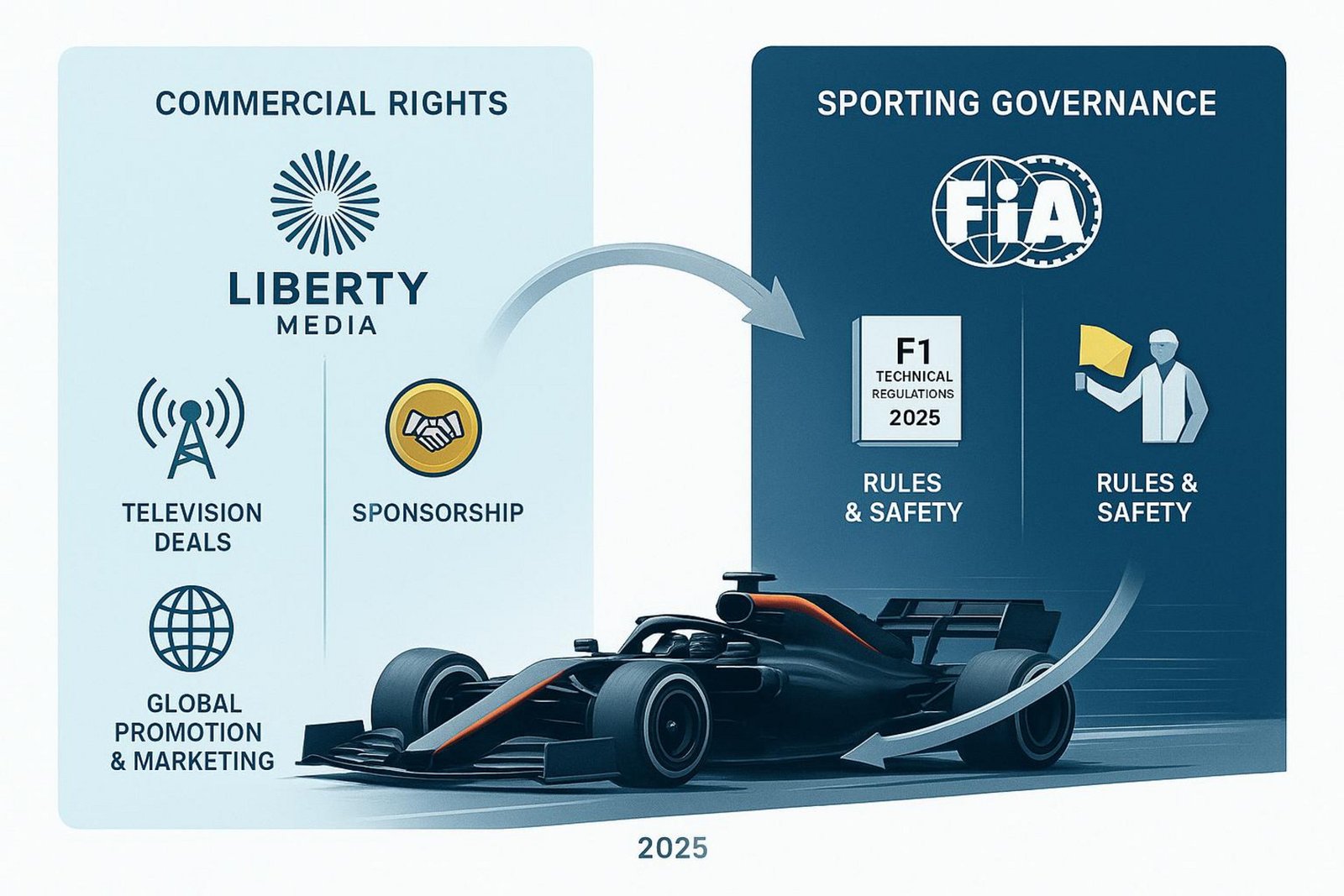
The Fédération Internationale de l'Automobile (FIA) is still the governing body that sets the technical rules and sporting regulations. Liberty Media, through its subsidiary, the Formula One Group, controls the business side of F1, including TV deals, race hosting fees, sponsorship, and promotion.
This split between ownership and governance is key to understanding how F1 works. Liberty Media's purchase moved the sport from the older, Bernie Ecclestone-controlled model to a modern, media-focused, global entertainment product.
Their main goals have been to grow F1's audience, especially in new countries, and to connect with younger and more varied fans through digital content and strong use of social media.
What Is Formula 1 Ownership?
F1 ownership cannot be summed up by pointing to just one person or company. Instead, it involves a mix of commercial control and sporting authority that has changed a lot over the years.
This separation matters, because it keeps the business side of F1 distinct from the sporting and regulatory side.
At its base, Formula 1 is a global motorsport business that runs the FIA Formula One World Championship. This includes many different activities, such as signing contracts with race venues, managing worldwide television rights, and licensing the F1 name and logo.
This structure supports the running of one of the most famous annual sports series on the planet, with races across several continents and a huge worldwide audience.
Entities Holding Commercial Rights to F1
The commercial side of Formula 1 sits inside the Formula One Group, a subsidiary of Liberty Media Corporation. This group is responsible for finding and managing revenue across the sport.
One of its main companies is Formula One World Championship Limited (FOWC), which holds the exclusive commercial rights to the FIA Formula One World Championship. FOWC handles the contracts for hosting Grands Prix, TV agreements with broadcasters around the globe, and the licensing of F1's intellectual property, such as the F1 logo and other branding.
Another key company is Formula One Management (FOM), the main operating arm of the group. FOM controls broadcasting, event organization, and promotional rights. It produces the TV feed for all practice, qualifying, and race sessions, which is then sent to broadcasters worldwide.
Beyond TV, FOM organizes the huge logistics operation needed to move cars, equipment, and personnel from race to race. It also helps fund some new tracks and sometimes new teams to grow F1's presence in more countries.
This wide control over how the sport makes money is why the Formula One Group sits at the center of F1's financial system.
Difference Between Governance and Ownership in F1
The Formula One Group, under Liberty Media, owns and controls F1's commercial rights and business activities. The FIA, on the other hand, looks after the rules and sporting side.
The FIA is the international governing body for motorsport and officially sanctions the Formula One World Championship. Its role includes writing the technical rules for the cars, setting the sporting rules, grading and approving circuits, and issuing racing licenses to drivers.
This clear split means Liberty Media handles the money and promotion, while an independent body - the FIA - controls the rules and safety standards. The FIA supplies stewards, race directors, and other officials to apply the regulations and protect safety.
In simple terms, Liberty Media owns the business package that presents F1 to the public, and the FIA controls the sport from a rules and safety angle. This separation is meant to keep business interests from overriding fair competition and safety standards.
How Has F1 Ownership Changed Over Time?
The story of who owns F1 is one of changing power, smart business moves, and an ongoing push to grow the sport worldwide.
For many years, one man stood at the center of this story and turned F1 into the huge commercial product it is today. Later, major investment firms stepped in, and finally Liberty Media took charge, each leaving a lasting impact on how F1 is run.
In the early days, F1 was more of a loose collection of separate races and teams. Race organizers often ran their own commercial deals, with little central control. This approach limited the sport's ability to grow as a unified, global business.
Turning F1 into a multi-billion-dollar product required someone who could centralize the commercial side and sell the championship as a single, worldwide package. That is where Bernie Ecclestone came in.
Bernie Ecclestone and the Rise of the Commercial Rights
Bernie Ecclestone is closely linked with F1's commercial growth. He entered F1 as the owner of the Brabham team in 1971 and quickly saw that the commercial rights had huge potential.
In 1978, he became the head of the Formula One Constructors' Association (FOCA). This was a turning point that led to his long period of control. Ecclestone's key move was to bring teams together so they negotiated as one group instead of on their own with track owners. This group bargaining made it possible to sign better TV contracts and turn F1 into a major TV event.
The 1981 Concorde Agreement was a major step. It gave FOCA the right to negotiate TV deals for the championship. Under Ecclestone, the Formula One Group was formed in 1987, and he gained wide control over commercial rights, such as TV rights, advertising, and race promotion. He became the sport's main commercial leader, carefully managing its public image and income. He set up Formula One Promotions and Administration (FOPA), which later became Formula One Management (FOM), to run these rights and collect a large share of TV and race fees.
During this period, F1's earnings rose sharply and its global reach expanded, although this came with frequent disputes and power battles with the FIA.
CVC Capital Partners Era
After Bernie Ecclestone's long run, Formula 1's ownership moved into the hands of major financial investors, starting with CVC Capital Partners. This private equity firm began buying stakes in the Formula One Group in the mid-2000s and kept building its share.
By March 2006, CVC held 63.4% of the Formula One Group, making it the majority owner. F1 was now mainly controlled by an investment firm rather than one strong individual.
During CVC's time, F1 continued to grow commercially, but there was also strong criticism. Some figures in the paddock, such as Force India's deputy team principal Bob Fernley, accused CVC of focusing too heavily on taking cash out of the sport instead of reinvesting in its long-term future.
CVC considered taking the company public with an IPO on the Singapore Stock Exchange in 2012, but that did not go ahead. It then sold parts of its stake to other big investors like Waddell & Reed, BlackRock, and Norges Bank.
Overall, CVC ran F1 with a corporate, investment-focused approach, preparing the ground for a later sale to a new owner: Liberty Media.
Liberty Media's Acquisition and Vision
The latest major change in F1 ownership came in late 2016, when Liberty Media Corporation agreed to buy a controlling stake in the Formula One Group for about $4.4 billion. The deal closed in January 2017, bringing a fresh leadership style to F1.
As part of this change, Liberty bought out Bernie Ecclestone's remaining shares and moved him out of day-to-day control.
Liberty Media had a clear plan: modernize the sport, grow its audience, and make it more appealing and open to younger fans. They soon updated the F1 logo and pushed hard into digital media. This meant stronger activity on social platforms and the launch of F1 TV, a streaming service that lets fans watch live races and extra content online.
One of Liberty's biggest successes has been its work with Netflix on the "Formula 1: Drive to Survive" series. This show brought many new fans to the sport, including people who had never watched F1 before.
Liberty also focused on growing in new markets, especially the United States. They added races in Miami and Las Vegas, giving the U.S. three Grands Prix on the calendar.
Many inside F1, including former F1 managing director Ross Brawn, have praised Liberty's focus on improving the sport and fan experience rather than just chasing short-term profit.
Who Owns F1 Today?
As of December 2025, Liberty Media Corporation controls the commercial side of Formula 1. This U.S.-based media company, headquartered in Englewood, Colorado, has led F1 into a period of strong global growth and higher revenue. Its 2017 purchase moved F1 from the long period of Ecclestone's personal control into a structure centered on a large, publicly traded entertainment group.
Liberty's plan has been to use its experience in media and entertainment to turn F1 into a more open and engaging global brand. Its influence runs through every part of how F1 is presented, from race promotion and broadcast formats to how the brand interacts with fans around the world. This combined approach has increased F1's income and also widened its cultural impact, particularly in markets like North America.
Liberty Media Corporation: Majority Owner
Liberty Media Corporation is the main owner of the Formula One Group. This American media company, led by Chairman John Malone and CEO Greg Maffei, has a broad range of interests across radio, sports, and entertainment. Its choice to buy F1 in 2017 for about $4.4 billion reshaped the business of motorsport. F1 sits inside Liberty Media as one of three main tracking stock groups, alongside the Liberty SiriusXM Group and the Braves Group.
Liberty's style with F1 has been forward-looking and focused on fans. It saw that F1 could reach far beyond the usual motorsport audience and took steps to widen its appeal. This meant serious investment in online content, social platforms, and new storytelling formats such as Netflix's "Drive to Survive." That show has played a major role in drawing in younger fans and people from countries where F1 was less popular.
Liberty has also put effort into building F1 in the United States and other key growth markets, reshaping how the sport earns money and how it presents itself to the wider public.
Key Shareholders and Stake Distribution
While Liberty Media is the main controlling owner, the Formula One Group is also listed on the Nasdaq stock exchange. Its shares trade under the tickers FWONA (Series A) and FWONK (Series C). This means that, alongside Liberty's controlling stake, many other investors own pieces of the business through public markets.
For example, as of late 2024, Warren Buffett's Berkshire Hathaway held a large stake in Liberty Media's F1 business worth about $630 million. The presence of such investors shows the scale and financial appeal of F1's current structure.
Ownership is spread across a range of institutional and individual shareholders, which is common for big listed companies. Liberty keeps overall control and sets long-term strategy, while other investors provide extra capital and oversight.
This mix supports both strong direction from a main owner and wide backing from the market. FWONK's share price has grown well since its initial listing in 2016, giving many investors solid returns and reflecting confidence in F1's future.
Formula One Group Structure Explained
The Formula One Group, Liberty Media's direct subsidiary for F1's commercial side, is made up of several linked companies. Each handles a specific area of the championship's business, legal rights, and licensing. Together, they run and monetize the FIA Formula One World Championship.
| Entity | Main Role |
| Formula One World Championship Limited (FOWC) | Holds exclusive commercial rights to F1 (2011-2110); negotiates race contracts, TV rights, and licensing fees |
| Formula One Management (FOM) | Main operating company; runs broadcasting, event organization, global TV feed production, and promotion |
| Formula One Licensing BV | Owns and licenses F1 trademarks and branding, including the F1 logo |
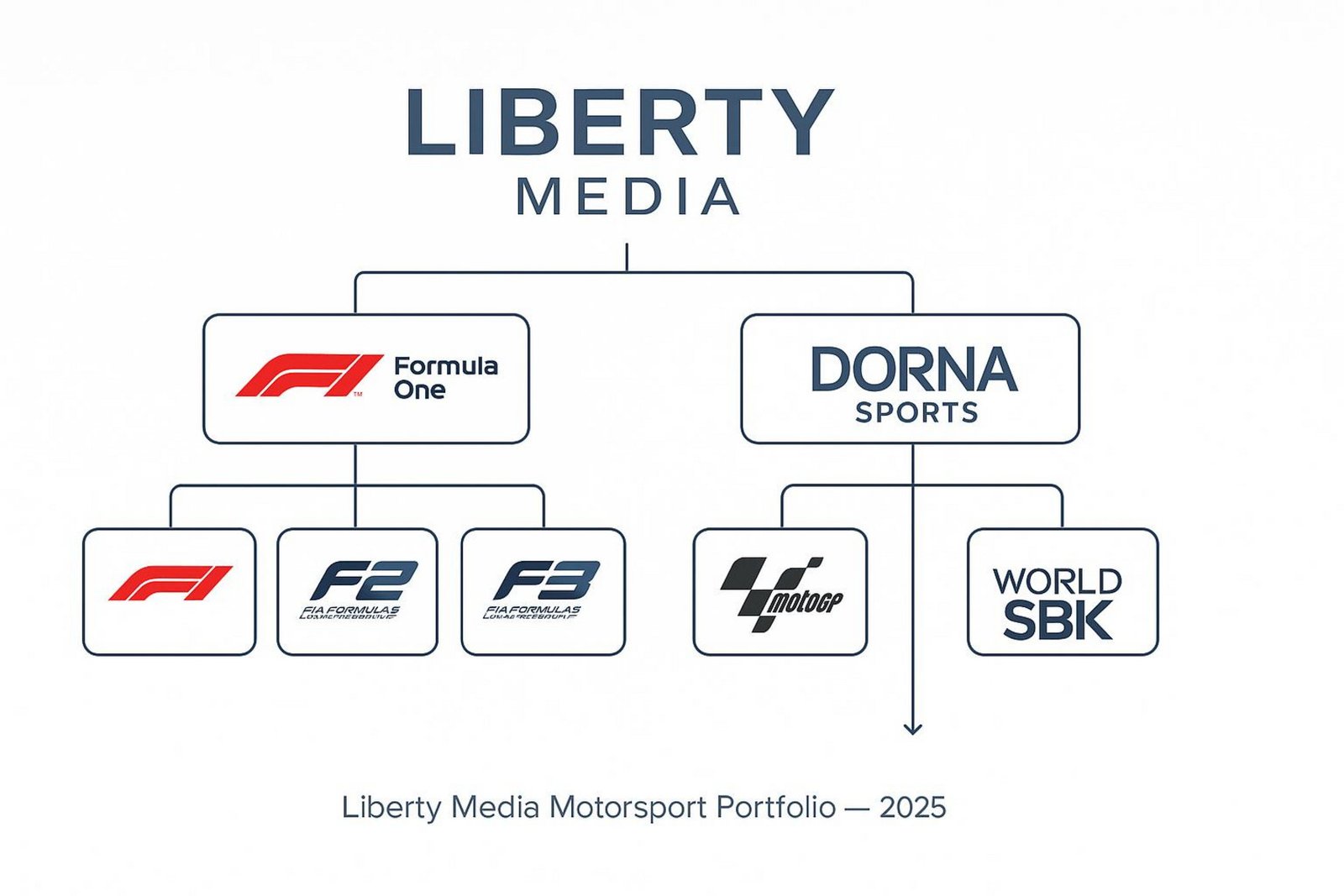
| Formula Motorsport Limited | Organizes feeder series such as FIA Formula 2 and Formula 3 |
| Dorna Sports, S.L. (majority stake) | Controls MotoGP and Superbike World Championship (brought under Liberty's motorsport portfolio by 2025) |
FOWC sits at the top of the commercial structure, with a 100-year deal (starting in 2011) giving it exclusive control over F1's commercial rights. It signs agreements with race promoters, broadcasters, and licensees. Below it, FOM handles the day-to-day work of putting on the show: producing TV coverage, coordinating schedules, and managing logistics.
Formula One Licensing BV manages all trademarks, such as the famous F1 logo, and controls how they are used on merchandise, games, and other products. Formula Motorsport Limited runs junior series like F2 and F3, which act as stepping stones for drivers aiming to reach F1.
Liberty's majority stake in Dorna Sports widens the overall motorsport portfolio to include two-wheel championships like MotoGP and WorldSBK. This layered setup allows each part of the business to focus on its own role while supporting the growth and global reach of Formula 1 as a whole.