
Why Do F1 Cars Spark?
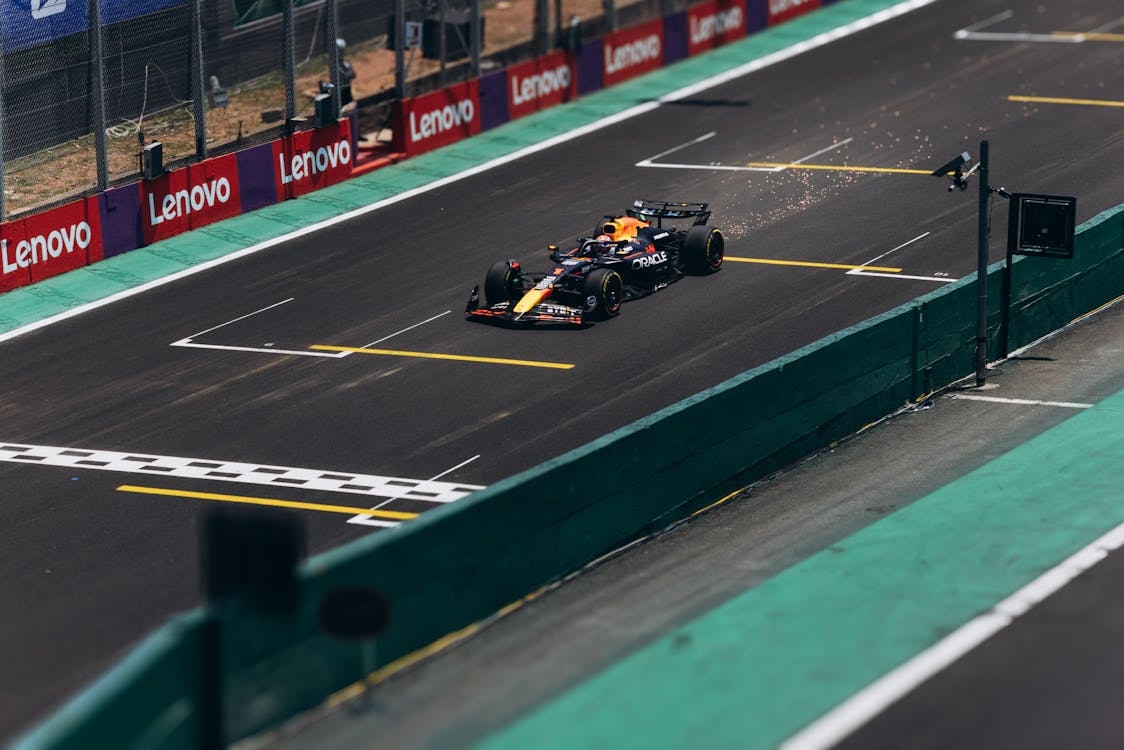
That glowing trail beneath a Formula 1 car is more than a visual effect - it is engineered. Titanium blocks on the car's underside are built to scrape the track when the car runs at minimal ride height, burning off tiny particles that glow white-hot at speed. What you are seeing is the car performing exactly as designed.
F1 cars spark because special parts on the underside of the car are made to touch the track on purpose. This is not a sign that something is breaking. It is a controlled effect that comes from how the cars are built for maximum performance while still meeting strict safety rules.
The sparks show that the car is running very close to the ground for better aerodynamics and that its protective parts are doing their job.
The sparks are not random. They come from the way these cars are set up and driven. Details like ride height and the materials used underneath the car all help create the effect. It shows how modern technology, aerodynamic design, and safety rules all come together in Formula 1.
Physics Behind F1 Car Sparks
The science behind F1 sparks is mainly about friction and the properties of metals. On the bottom of the car are titanium skid blocks. When the car runs low enough that these skids scrape the rough track surface, friction creates a lot of heat.
Tiny pieces of titanium get so hot they burn and glow, which is what we see as bright sparks. At racing speeds this effect is stronger, because greater speed means more energy and more force pressing the car into the track.
Engineers aim for a fine balance. The car should be as low as possible for better downforce and grip, but not so low that important parts are damaged. The sparks show that the car is running right on that edge.
The metals used are chosen not only for strength, but also because they wear in a controlled way and create visible sparks while protecting the structure above them.
Role of Ride Height and Downforce
Ride height (how high the car sits off the ground) and downforce (how hard the air pushes the car down) are closely linked to sparking.
F1 cars are set up with very little ground clearance to get more aerodynamic grip. The airflow under the floor helps "suck" the car down onto the track, and this effect is strongest when the car runs close to the surface.
As speed goes up, downforce goes up too. On fast sections, the car is pressed even closer to the track. When it hits bumps, dips, or kerbs, the floor and titanium skid blocks can hit the asphalt and send sparks flying.
What you see is the power of the aerodynamics literally pushing the car into the ground until those skids touch.
How Track Surface and Speed Influence Sparks
The shape and texture of the track, along with speed, decide how often and how strongly a car sparks. No circuit is perfectly flat. Tracks have bumps, small waves, and kerbs with different heights and roughness.
Street tracks like Monaco or Singapore and circuits with large elevation changes, such as Spa-Francorchamps or the Red Bull Ring, tend to produce more sparks because cars are more likely to hit the ground there.
Speed is the other key factor. Faster speeds create more downforce and push the car harder into the tarmac. This, together with low ride height, makes floor contact more likely.
Even small changes in height in the track surface can cause sparks at those speeds. Smoother tracks with gentle kerbs usually lead to fewer sparks, which shows how strongly sparks depend on both track conditions and speed.
Which Parts of an F1 Car Produce Sparks?
Sparks do not come from just any part rubbing on the track. They come from specific, controlled components that are built for safety and performance.
The Wooden Plank and Its Purpose
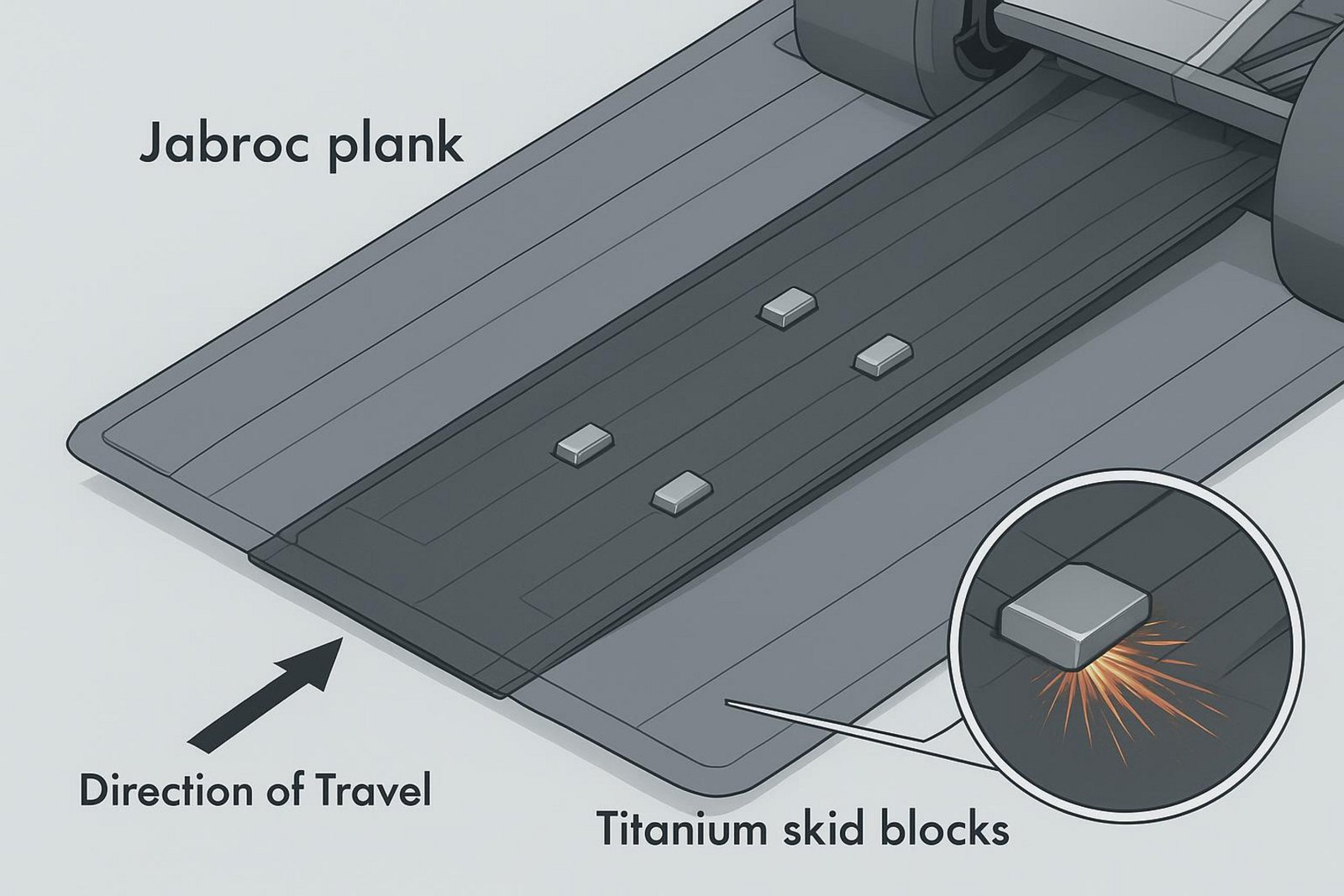
Under every F1 car, down the middle from near the rear wheels to just before the front wheels, is a long piece known as the "plank" or "skid block." People often call it wooden, but it is made from Jabroc, a beechwood-based composite with layers and resin. The FIA brought this plank in after the 1994 San Marino Grand Prix as a safety measure.
The main job of the plank is to control minimum ride height. The FIA sets its thickness at 10mm when new and allows only 1mm of wear during a race. This stops teams from running the car too low for extra aerodynamic grip.
If, after a race, the plank is worn by more than 1mm, it shows the car was too low, and the driver can be disqualified. The plank is therefore a physical measure that keeps cars within safe and legal limits.
Titanium Skid Blocks: Function and Materials
The sparks themselves come from metal skid blocks fitted into the plank. These titanium pieces stick out up to 3mm below the plank and are placed in key areas so they touch the track first when the car bottoms out. Their main job is to protect the Jabroc plank from wearing away too quickly.
When these titanium skids scrape along the tarmac, friction and heat cause tiny metal particles to burn and glow, making the sparks. This clever setup lets teams run very low ride heights for better performance, while the skids take the impact and keep the plank within the legal thickness range.
Why Titanium Is Chosen for Skids
Titanium is used for several good reasons:
- High strength and wear resistance: It can handle frequent hits and high temperatures without failing.
- Spark quality: When ground against the track, titanium gives off bright, easy-to-see sparks, especially at night. This was one reason it was brought back in 2015 after a period using metals like tungsten that sparked less.
- Safety: Earlier metals sometimes cracked or broke into sharp pieces that could puncture tires. Titanium tends to wear away smoothly instead of shattering, making it safer.
- Weight: It is lighter than some alternatives, helping keep overall car weight down.
Why Are F1 Cars Designed to Spark?
Sparks are not a mistake or a problem that teams try to remove. They come from safety rules and design choices that aim to get the best performance while staying inside the regulations. The light show is an extra bonus for fans.
Safety Regulations and the Purpose of the Plank
The main reason F1 cars spark goes back to safety changes, especially the introduction of the plank in 1994.
After the deaths of Roland Ratzenberger and Ayrton Senna, the FIA wanted to reduce the dangers created by very high speeds and unstable aerodynamics. One key step was to stop teams running their cars extremely low, which could cause the airflow under the car to stall and make the car suddenly lose grip.
The plank is a physical control that makes sure teams keep a set minimum ride height. Titanium skid blocks built into the plank let cars run close to that limit and still protect the plank. The sparks are a visible sign that those skids are touching the track and taking the wear, keeping the plank within its legal thickness.
This stops teams from using unsafe, ultra-low setups and helps keep conditions fair.
Visual Spectacle: Do Sparks Benefit the Show?
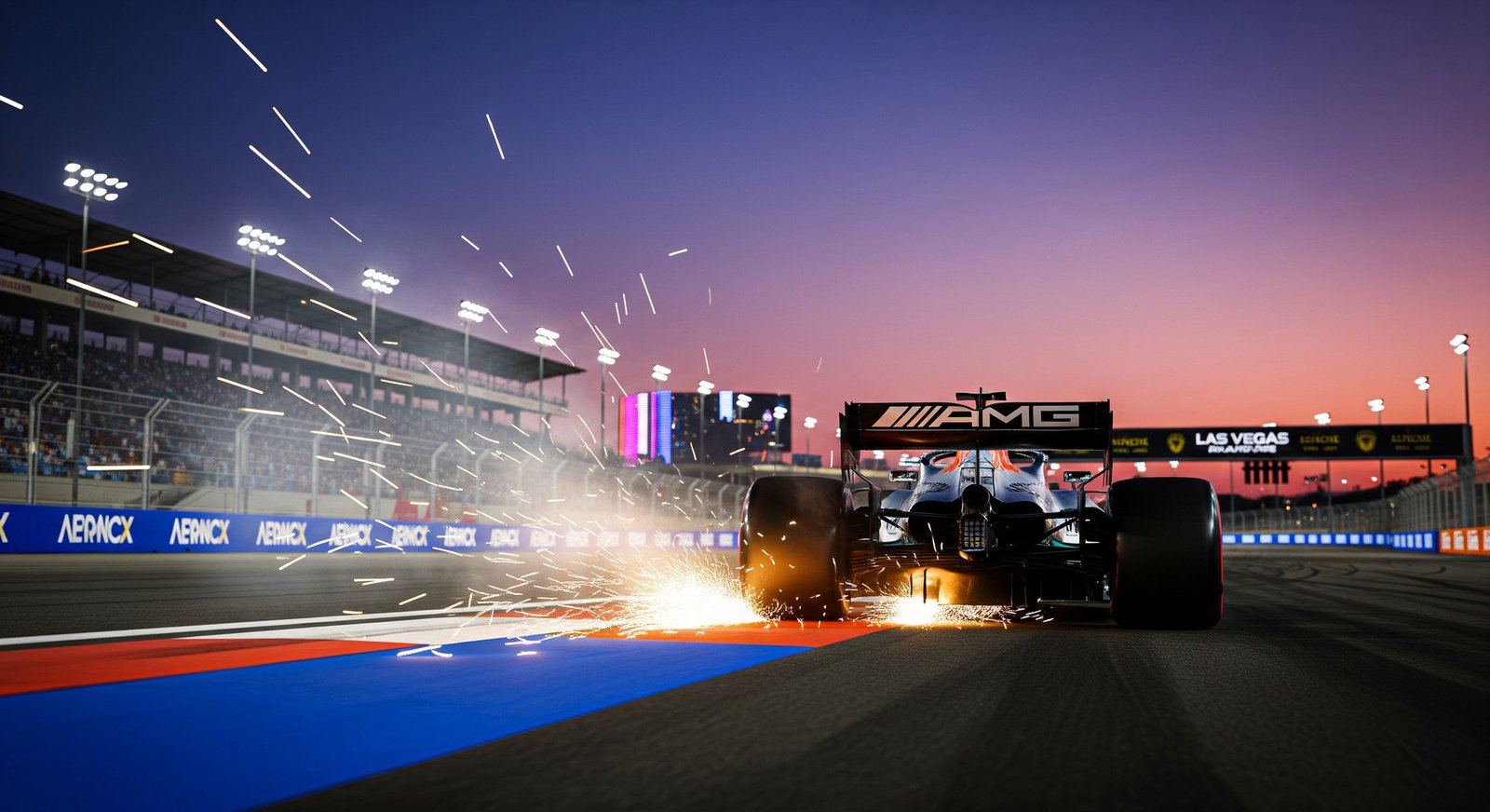
While safety and rules are the main reasons for planks and skids, the sparks themselves add a lot to the show. At night races, especially, they turn high-speed runs and hard cornering into eye-catching moments that fans remember.
When titanium skids returned in 2015, the choice of material was partly because they spark clearly and consistently. The FIA and the sport's organizers knew that this makes races look more exciting, as long as safety is maintained.
So, even though sparks started out as a side effect of safety rules, they are now also a deliberate way to add more drama for viewers.
When Do Sparks Most Often Occur During a Race?
Sparks do not appear constantly all lap long. They are more common in certain places and conditions, when the car is pushed closest to the track.
Long Straights and High-Speed Sections
You often see the most sparks on long straights and other very fast parts of a circuit. At top speed, the car generates its highest downforce. This pushes the car down, lowers the effective ride height, and makes it more likely that the floor and skids will touch the track.
Even a straight that looks flat can have tiny humps and dips that matter at racing speeds. As the car passes over them, it can bottom out briefly and throw sparks. The faster the car goes, the stronger this effect becomes.
Over Bumps, Kerbs, and On Track Elevations
Sparks are also common when cars hit bumps, run over kerbs, or pass through sections with large height changes. Kerbs are usually higher and rougher than the main racing surface. If a driver rides them hard with a low setup, the titanium skids almost certainly touch down and spark.
Circuits with steep climbs and drops, like Eau Rouge at Spa or parts of Interlagos in Brazil, are known for this. As the car compresses into a hollow or comes down from a crest, the floor can hit the ground for a moment.
Even small bumps in the asphalt, formed over time by tire loads and heat, can trigger sparks at racing speed.
During the Start and Heavy Fuel Loads
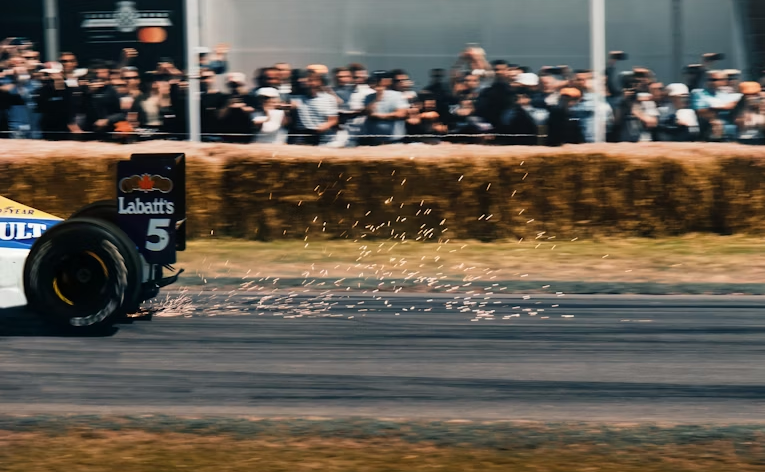
The start of a race is another time when sparks are especially common. At lights-out, each car is at its heaviest because of the full fuel tank, which can hold around 110kg of fuel. This extra weight lowers the car and increases the chance that the floor will touch the track under acceleration and rising downforce.
As the race goes on and fuel burns off, the car gets lighter and its ride height rises a little. That means it bottoms out less often, so you usually see fewer sparks in the later stages compared to the opening laps.
How Do Tracks and Setups Influence F1 Car Sparks?
The number and location of sparks depend not just on car design, but also on each circuit and the choices teams make in their setups.
Track Sections Where F1 Cars Spark Most
Some tracks are famous for producing more sparks than others because of their layouts and surfaces. Long, fast straights are obvious hot spots, but so are tracks with strong elevation changes.
Corners like Eau Rouge (Spa), the flowing hills of Suzuka in Japan, and parts of the Red Bull Ring in Austria are typical examples. The ups and downs there push cars into the ground at certain points, which leads to regular contact between the floor and track.
Street circuits like Monaco, Singapore, and Baku also create a lot of sparks. Their surfaces are often bumpier and less uniform than permanent race tracks. They can have sharp kerbs and frequent small level changes.
Night races such as Jeddah, Las Vegas, and Abu Dhabi make the sparks even more visible, making them a strong part of the look and feel of these events.
Car Setup Choices and Their Effect on Sparks
Teams spend a lot of time tuning the car for each circuit, and these choices have a direct effect on sparking. One of the most important variables is ride height. Lower is better for downforce, but too low wears the plank too much and risks penalties.
Engineers must find a workable middle ground. A stiffer suspension can keep the car stable through corners but may make it hit the ground more over bumps. A softer setup may soak up bumps but can lead to extra movement front to back or side to side, which may cause scraping in different places.
The angle of the rake (front vs rear height) and the stiffness of springs and dampers all change how the car moves over the surface, and so change when and where sparks appear.
Does Sparking Cause Damage to F1 Cars?
Seeing a car throwing a long tail of sparks can make it look like something is being badly damaged, but this is usually not the case. It mostly shows that the protective parts are doing what they are meant to do.
Impact of Sparks on Car Components
The sparks that you see come from material worn off the titanium skid blocks. These pieces are expected to wear during a race. They are sacrificial parts, made to take the contact instead of more sensitive components. The underfloor and chassis use strong, heat-resistant materials like carbon fibre, which are built to handle the brief high temperatures and abrasion from these contacts.
Sparks can leave small marks on things like a visor or bodywork, but these are usually only cosmetic and do not affect performance or safety. The car is built with the expectation that some scraping and sparking will happen.
Plank Wear and FIA Disqualification Risks
The real concern linked to sparking is not the sparks themselves, but what they say about plank wear. The titanium skids are there to shield the plank. If the car is set too low or driven very hard over kerbs and bumps, the skids can wear down more quickly and the Jabroc plank underneath can start to wear more than allowed.
The rules are clear: the plank starts at 10mm and must not wear below 9mm by the end of the race. If post-race checks show more wear than that, the car is illegal and is disqualified. This happened to Michael Schumacher in 1994 and again in 2023 to Lewis Hamilton and Charles Leclerc after the United States Grand Prix.
So, while the sparks themselves are harmless, heavy plank wear linked to frequent bottoming out can bring very serious consequences.
Conclusion
The sparks behind a Formula 1 car are far more than a fun light show. They come from the mix of extreme speed, low ride heights, and the safety hardware built into every car. The plank and its titanium skid blocks, the powerful downforce, and the bumps and kerbs of each circuit all join together to create the fiery trail fans see on TV.
Teams are always walking a fine line: low enough for performance, high enough to protect the plank and avoid penalties.
The sparks tell us, in real time, that the car is right on that edge. They are a visible sign of how hard drivers and engineers are pushing, and a reminder that even the parts meant to wear away have an important role in keeping Formula 1 fast, safe, and spectacular to watch.
Common Questions About F1 Car Sparks
The eye-catching nature of sparks leads many fans to ask similar questions. Here are some of the most frequent ones.
Why Do Some Cars Spark More Than Others?
Cars do not all spark the same amount, even in the same race. There are several reasons for this:
- Setup differences: Some teams run lower ride heights, stiffer suspensions, or different rake angles. A more aggressive low setup usually means more sparks.
- Driving style: Drivers who attack kerbs harder or use more of the track over bumps will often produce more sparks.
- Car weight during the race: At the start, full fuel loads make all cars heavier, which increases bottoming out and sparks. As fuel burns off, the car becomes lighter and tends to spark less.
So the amount of sparking you see is a mix of engineering choices, how the driver attacks the circuit, and how far into the race they are.
Are Sparks a Sign of Performance Issues?
Sparks are usually not a warning sign of poor performance or a failing part. In many cases it's the opposite: they show that the car is running very low, with strong downforce and an aggressive setup that should give better lap times.
The titanium skids are doing exactly what they are meant to do - protecting the plank while allowing teams to use low ride heights. If a car never sparks at all on a track with bumps and fast sections, it could suggest the ride height is quite conservative, which may cost some aerodynamic performance.
The only real problem comes if the underlying plank wears too much and the car breaks the thickness rule. That is a long-term risk over a race distance, not an instant failure caused by a few sparks.