
Miami 2026 Track Limits: How the FIA's Blind Spot Cost Lawson His Session
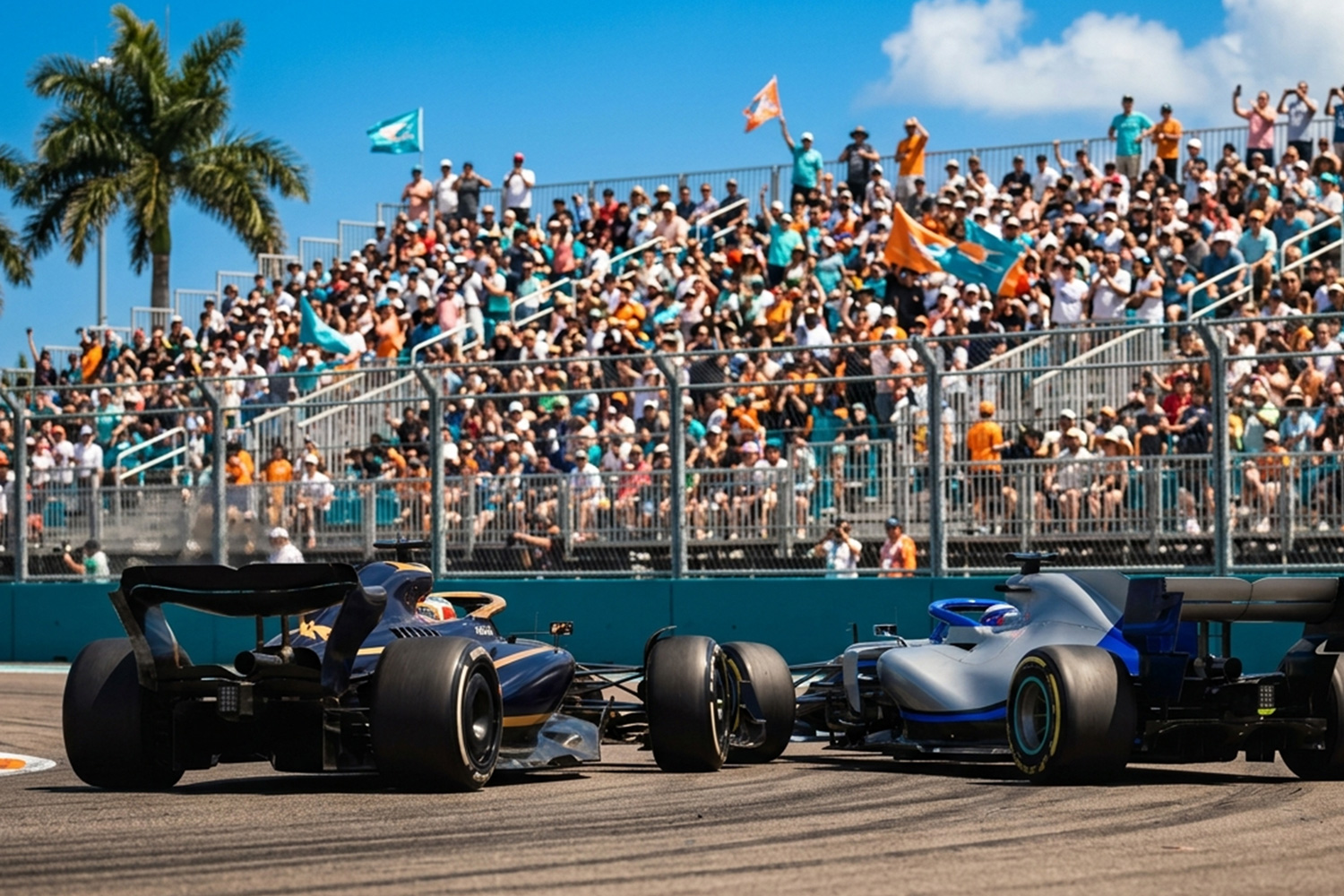
Liam Lawson sat in his Racing Bulls cockpit on Friday in Miami waiting for a decision he should have already had. Alex Albon had bumped him from the cut for SQ2 with a lap that crossed the white line at Turn 6 — but the FIA's track limits system never flagged it. By the time the stewards caught up, SQ2 was running, Albon was on track, and Lawson's session was gone. The 2026 reforms that were meant to clean up F1's officiating don't touch this kind of failure at all.
How Miami's F1 sprint track limits failure happened
Friday, May 1, 2026. Miami International Autodrome. Final laps of SQ1 are coming in. Albon's Williams crosses the line at 1m30.216s — fast enough for P16 and a ticket to SQ2. Lawson, six hundredths back, ends his session at P17.
Then the wait. Racing Bulls' engineers spotted something on Albon's onboard footage: a Turn 6 kerb-skim beyond the track edge. Lawson, already weighed and out of the car, was told to climb back in. The team's read: if the FIA caught it before SQ2 rolled, Albon's lap got deleted, Albon dropped out, Lawson went through.
The FIA didn't catch it. SQ2 started with Albon on track. A federation spokesperson told Motorsport.com that the automated track-limits system at Turn 6 was confused by rubber smeared across the asphalt by support series running the same weekend — F2, McLaren Trophy America and the Porsche Carrera Cup. Race director Rui Marques only flagged it on a manual check, after SQ2 had already begun.
When the stewards finally ruled, they invoked Article 11.7.1.a of the International Sporting Code — an equity clause that lets them settle "unusual situations" by tossing the offending lap. They went further. Not just Albon's SQ1 time, but every lap he set in SQ2 was deleted. He started the sprint from P19 instead of a provisional P14. The table moved Lawson from P17 to P16. Lawson never drove SQ2.
While the controversy was rumbling on Saturday morning, Lando Norris turned the noise down by simply winning the sprint from pole. McLaren took its first 1-2 of 2026, and papaya fans got the kind of weekend they'd been waiting for since the Hungarian GP last year.
Lawson's lost session — what actually got taken from him
Six hundredths of a second. That's the margin Lawson missed SQ2 by, sitting at P17 to Albon's P16 after the chequered flag. In a sprint format where SQ1 only runs twelve minutes, every breath of clean air on a final flier matters. Lawson had his. Albon had his too — except Albon's came with a wheel over the white at Turn 6.
When the news finally reached Lawson that the lap was being investigated, the New Zealander didn't try to hide his confusion. He told Racing Bulls' broadcast partner that Albon had clearly run wide at Turn 6 and that the call had come too late — Albon was already out on track for SQ2 by then. "I honestly can't understand how that's possible," he said.
Here's the cruel part. Lawson now has SQ1's P16 in the FIA table. He starts the sprint from P16. But the table doesn't translate into reality. A driver who advances to SQ2 sees how rivals lap, learns the car on a fresher set of tires, builds confidence into Saturday. Lawson got none of that. He got a number on a piece of paper.
Williams lost in a different direction. Albon had been quick all weekend in a car the team thought might surprise; the dual-deletion knocked him from P14 to P19, where any sprint upside was gone.
This isn't new — Hulkenberg, Pérez and the same broken pattern
If Miami felt familiar, that's because it's the third version of the same story in four years.
Bahrain 2025. Nico Hulkenberg, then in the Sauber, set a Q1 lap that put him into Q2 — and crossed the white line in the process. The FIA missed it. Hulkenberg ran Q2, the lap was eventually struck post-session, but the driver he'd knocked out in Q1 didn't get to come back. That driver was Alex Albon. The same Alex Albon, now driving for Williams, standing on the wrong side of the same procedural failure twelve months later. In professional motorsport, you don't usually get to play both roles in the same script.
Austria 2022, sprint shootout. Sergio Pérez's Red Bull crossed track limits on the lap that pushed him into SQ3. The breach was only caught long after SQ2 had finished. Pérez kept his SQ3 run on the day, qualified P4 for the sprint — only to have the lap deleted later, dropping him to P13. The driver who should have been in SQ3 in his place was Pierre Gasly. Gasly never drove the segment.
Three cases. Same mechanism: detection lag, post-session correction that arrives too late to give the wronged driver an actual session. Each time, someone loses a piece of competition that can't be returned by adjusting a table.
The stewarding drama of recent seasons hasn't been confined to Williams and Sauber. Mercedes have been right at the center of officiating debates as well — usually on the receiving end of a call that didn't quite line up with the previous one.
Wider 2026 officiating drama — Sainz, Antonelli, Piastri
Track limits is one piece of a bigger picture. The last twelve months of F1 produced a steady run of stewarding decisions where the call was technically defensible but the timing or the consistency raised eyebrows.
Carlos Sainz, Dutch GP 2025. Contact with Lawson at Turn 1 — yes, this is also a Lawson story — drew a 10-second penalty plus two points on the superlicense. Williams brought a right of review, dug up Lawson's onboard footage the original stewards hadn't seen, and got the points wiped. The 10-second penalty? Already served. Sainz lost a race result that, on the corrected evidence, he probably shouldn't have lost.
Kimi Antonelli, Shanghai sprint, March 2026. Contact with Isack Hadjar at Turn 6 on the opening lap. Ten-second penalty for being ruled fully at fault. But here's the wrinkle: no penalty points. RaceFans openly called the stewards unusually lenient — the same incident in 2025 would have come with two points on the license, easy.
Norris's teammate Oscar Piastri lived the inverse a few months earlier. Brazil 2025: Piastri, Antonelli and Charles Leclerc tangled at Turn 1, three-way collision, McLaren ruled at fault. Ten-second penalty plus two points. McLaren argued for weeks that the move was inside normal racing room. They lost.
The pattern isn't that stewards are wrong. The pattern is that the cost of being wrong, or being right inconsistently, keeps landing on the driver who had a worse view of the angle that day.
The FIA's 2026 reforms target the wrong problem
The FIA hasn't been ignoring the criticism. The Qatar Grand Prix in November 2025 produced a meeting between drivers, the GPDA and the federation that became the most significant rewrite of the Driving Standards Guidelines in years. Penalty points are now reserved for "dangerous, reckless, or apparently deliberate actions resulting in a collision." Three rounds into 2026, not a single penalty point has been issued — a level of restraint that didn't exist a year ago.
The second reform was quieter and arguably mattered more. In December 2025 the FIA added Article 14.1.2 to the International Sporting Code: stewards can now reopen their own decisions on their own initiative if a significant new element surfaces after the fact. Previously only teams could trigger that. The change was a direct response to Sainz-Zandvoort, where Williams had to do the heavy lifting because the original panel never had Lawson's onboard footage.
Both reforms are real. Neither one fixes Miami.
The Driving Standards reset is about who deserves a penalty and how harshly. It doesn't change how fast a track limits breach gets caught during a session. The self-review power applies to decisions stewards have already made — it doesn't help when the problem is that nobody decided in time. Miami was a detection-and-process gap, upstream of the rulebook. The 2026 reforms didn't touch it.
What this means for the rest of 2026
The honest question after Miami is whether a fan can still trust what they're watching while they're watching it. If the order coming out of a session can change hours later — not because of dirty driving, but because of detection lag — then part of the live drama is in escrow until further notice.
This isn't an argument for piling on the FIA. The federation runs 24 weekends a year and a regulatory environment turning over harder than at any time since the early 2000s. The Driving Standards reform was a real response to real complaints. The right-of-review change closed a real loophole.
But the audience watching F1 in 2026 — that came in through Drive to Survive, that found the sport again through the Brad Pitt movie, that turned up at Vegas and Austin and Miami in numbers nobody expected — wants the call to land while the lights are still on. Lawson won't get SQ2 in Miami back. Sainz won't get Zandvoort back. Pérez never got Austria back. There are tracks the table can't redraw.
The choice the FIA faces isn't between stricter and gentler. It's between fast enough and right. Get one wrong and the entry list starts mattering more than what happened on the asphalt — and in an era of three-screen viewing and AI-summary headlines, that's a tax F1 can't keep paying.