
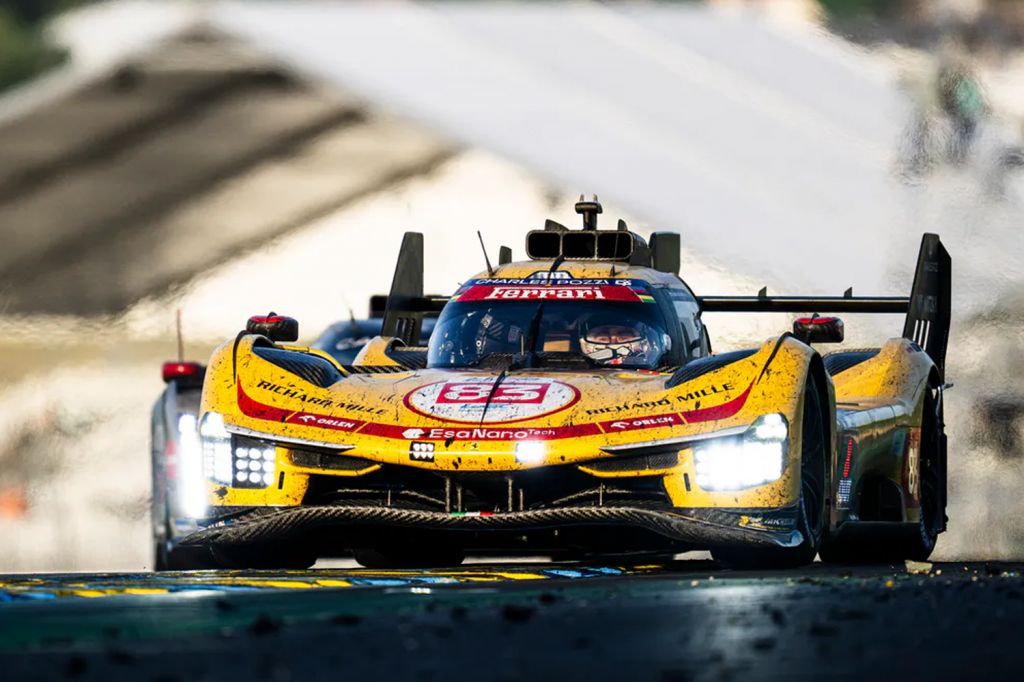
Twenty-four hours of racing, ten positions recovered, and a finish outside the podium. That sounds like a disappointment - and partly it was - but Robert Kubica came away from his sixth consecutive Le Mans start talking more about regret than failure. His focus landed not on the competitors who beat him but on a single call made in the opening hours that shaped every lap that followed. Alongside that story, the Polish chapter of this Le Mans closed with yet another Inter Europol Competition victory in LMP2.
Ten Positions Gained, Still Off the Podium
Kubica's crew crossed the finish line outside the top three but had climbed ten spots from their starting position. On paper that looks average; across a 24-hour race it reflects relentless, consistent work through an entire night and day. Kubica made no attempt to hide the fact that he expected more, but he was equally clear that his own driving gave him little cause for complaint.
The raw position in the results sheet does not explain this race. To understand it, you have to go back to the moment the script flipped - and that moment came very early, at the first safety car.
The Safety Car Call That Rewrote the Race
Kubica was direct about what went wrong: the team pitted four laps too late under the first full-course caution. Had they come in when the pit lane opened, the car would have rejoined around fifth place, roughly 30 seconds behind the leader. Instead, they emerged in 13th or 14th, two full minutes adrift.
He put it plainly: "It's a shame about the one wrong decision at the first safety car, which turned the whole scenario of this race upside down. We could comfortably have pitted and been around fifth, 30 seconds behind the leader - instead we came back out in 13th or 14th, two minutes behind the leader."
The crew managed to claw back roughly a minute through the night, but the pit stop rhythm was now out of phase with the front-runners. In endurance racing that kind of offset compounds itself - it shifts every subsequent pit window, meaning one early miscalculation keeps working against you hour after hour, right to the flag.
A Clean Run at the End Was the Wrong Kind of Clean
The second half of the race brought its own frustration: no useful neutralization. The final hours ran green and incident-free, which was exactly the wrong kind of luck for a crew trying to recover a strategic gap. The leaders could manage with a shorter stop; Kubica's car needed an additional fuel splash that cost time they could not afford to lose.
Kubica acknowledged a brief incident during a full-course yellow that ultimately had no major consequences, and a later safety car partially clawed back some of the deficit. But the damage from the opening hours was structural. No single move afterward could undo the chain of compromised pit windows that early call had created.
On His Own Driving: "I Left Very Little on the Table"
Strip away the strategic frustration and Kubica was openly satisfied with his performance behind the wheel. He described the race as intense from the night hours onward and felt he made no mistakes of his own that affected the result. By his own assessment, this ranked among the stronger Le Mans outings of his career.
Six consecutive starts at this race, and he called the result "nothing" in terms of silverware - yet spoke about genuine internal satisfaction. Le Mans tells you more about a driver than most races do, and Kubica was blunt in his self-evaluation: "Given what we had relative to the competition, I can be really happy with my work. It was intense from nighttime onward, and I left very little on the table for a 24-hour race."
Vibrations, Shortened Stints, and Two Hours of Sleep
The race also went sideways on the tire front. Kubica's opening stint was cut short by a vibration problem severe enough that on the following stint he could barely see. A second mid-race adjustment came at night, when track conditions and a slow zone made a tire change the right call - and the team took the opportunity to rotate the driver lineup at the same time.
His final run covered four stints as the crew pushed back toward the points. Sleep was minimal: two consecutive hours, which Kubica himself called a personal record for Le Mans. The way the driver swaps fell, especially through the night, meant he had to stay available to the team for long stretches. That side of endurance racing - the physical management, the fire-resistant underlayers, the FIA-homologated seat and harness as daily tools rather than accessories - is exactly what separates a 24-hour event from anything else in motorsport.
Toyota Won It, BMW and WRT Pushed Them Hard
Before the start, Kubica had named Toyota as the team to beat. After the race, he confirmed he called it right - though he added that the competition pressed them hard and it was no straightforward victory for the Japanese squad. WRT and BMW both fought for the top positions deep into the race, making the overall battle genuinely compelling even when his own crew was no longer a realistic factor at the front.
That distinction matters at Le Mans. One driver's pace never tells the complete story - the final result is always the sum of strategy, mechanical reliability, and the timing of neutralizations that no team controls.
A Harder Second Half of the Season Ahead
Asked about the rest of the campaign, Kubica kept his expectations measured. He acknowledged that the second half of the season has typically been more difficult for his team and specifically mentioned Brazil and Fuji as rounds to watch. There is also schedule uncertainty - he noted it is unclear how the calendar will close out and whether Qatar would be replaced by another venue.
Much will depend on the nature of the circuits and factors outside the team's control. That careful tone fits a driver who has just spent 24 hours learning, again, how quickly plans diverge from reality in long-distance racing.
Polish Victory in LMP2 - and a Tired Smiechowski
The strongest Polish story of this Le Mans belonged to Inter Europol Competition. Kubica congratulated the team on another LMP2 win and said he was not surprised - when he was running behind their cars during the race, the pace difference was obvious. In his words, Inter Europol at Le Mans can already be treated as the outright favorite in class.
That is not a throwaway compliment. After a third Polish victory in the category, it is a statement of fact. LMP2 at Le Mans does not reward raw speed alone - it demands a full 24-hour performance without dropping any piece of a complicated puzzle. Kuba Smiechowski crossed the line exhausted and happy. His immediate priority was sleep, though the celebration with the team and the photographs came first.
Asked whether wins stop feeling special after three of them and further podiums, he said that kind of success never gets old. He also pointed to the key to pulling it off: fighting to the end when the race looked lost. The team worked through problems with the left door, the right door, a door hinge, and the clutch - and still brought the car home first in class.
What Comes Next
Kubica planned a few days off to decompress and sort through everything mentally. Smiechowski said the same, but his schedule turns back to racing quickly - the next IMSA round is just two weeks out, with the rest of the LMS season to follow.
Le Mans 2026 showed both sides of endurance racing in one weekend. Kubica had the pace, delivered strong stints, and walked away stung by one strategy call. Inter Europol had serious problems and still won. The common thread: in a 24-hour race, the result is almost never a simple function of how fast the car is or how well the drivers performed. Everything else gets a vote too.