
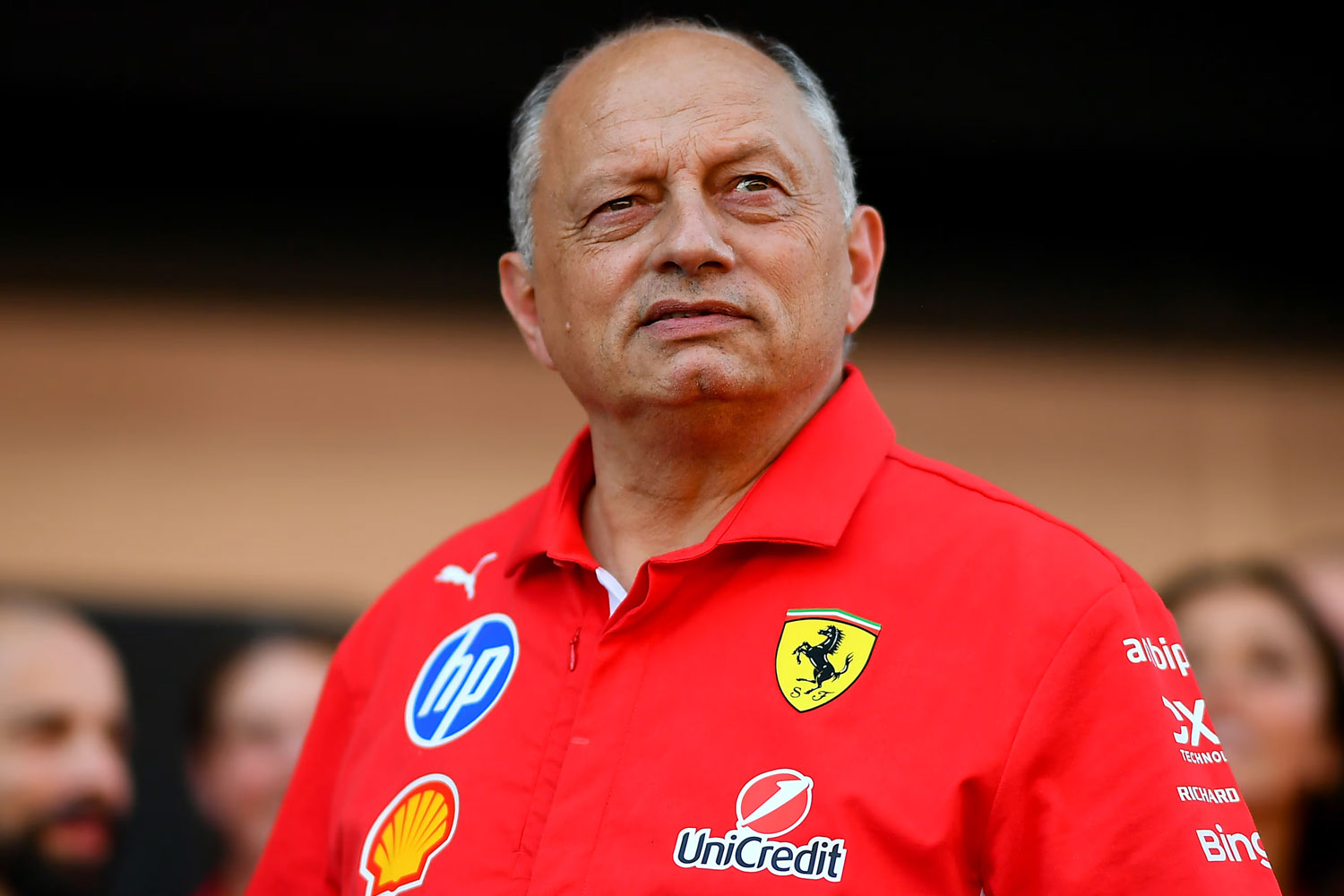
Someone lit a match at Friday's FIA press conference at Silverstone. Fred Vasseur, Ferrari's team principal, was supposed to field routine questions about the Scuderia's 2026 development pace. Instead he delivered one of the sharper public rebukes a team boss has aimed at a rival in recent memory. The target was Toto Wolff, and the trigger was Wolff's suggestion that Ferrari has been spending as if the cost cap does not exist. Vasseur did not hold back - and that is exactly why this exchange matters beyond the usual paddock noise.
What Wolff Said - and Why Vasseur Lost His Patience
After the Austrian Grand Prix, where Ferrari unveiled an engine-related upgrade just one race after a comprehensive aerodynamic overhaul, Wolff described the Scuderia's pace of development as that of a team that appears to be "limitless." It sounded almost like a compliment. The context made it anything but - Wolff was talking about the budget cap.
When Vasseur got the question at Silverstone, the irritation was visible. "I found it quite ironic, given that it was Toto from Mercedes saying it about Ferrari," he said. Then came the line that captures his entire argument: when Red Bull or Mercedes develops, people talk about engineering genius. When Ferrari does it, questions about regulatory compliance follow.
That was not an offhand remark. Vasseur deliberately held two different standards side by side. Nobody raised cost cap concerns when Mercedes pulled whole aero packages mid-season in previous years. Now, with Ferrari pushing hard in a new technical era, one of its biggest rivals is seeding doubt through the press.
Insinuation or Careless Comment? Vasseur Leaves No Room for Ambiguity
Journalists pressed Vasseur for a cleaner definition. When asked whether he believed Mercedes was accusing Ferrari of cheating, his answer was direct: "If you think we have gone over the cost cap, for me it goes in that direction."
That distinction matters. Wolff never said "Ferrari is cheating" - he said something more carefully worded. In a paddock where every syllable from a team principal gets dissected, framing a rival as "limitless" in the context of a spending cap is not a neutral observation. A lawyer might put it this way: he threw the stone, then hid his hand.
Vasseur clearly read it exactly that way and had no intention of letting that narrative harden without a response. When the questioning continued, he redirected journalists straight to the source: "If you have a question for Toto, go to Toto. Ask him why he was talking about me. Don't ask me. Honestly, I have no idea."
How Many Updates Has Ferrari Actually Brought - and Is That Unusual?
The key fact that got lost in the noise: Vasseur stated outright that Ferrari has not brought more parts than Red Bull or other teams. The Race confirmed as much when it analyzed the official FIA aerodynamic update declaration documents - Ferrari's 2026 update rate runs comparable to Red Bull's and even to Cadillac, which is building an entirely new project from scratch.
So why does Ferrari look "limitless"? Vasseur offered one answer himself: the FIA declaration system can be misleading. Since 2022, every team must publicly declare changes to the shape of aerodynamic surfaces. The problem is there is no standardized method for classifying those changes. One team might split a substantial modification into several smaller declarations; another logs it as a single entry. The result: the number of line items on the list does not map directly onto spending scale or actual performance gain.
"If you have an idea for new regulations, we will listen," Vasseur said, with a dry edge. "The FIA asks us to declare shape changes. We do it so you have something to write about. If you don't want to understand it, that's a different story."
Ferrari's Strategy: Load the Updates Early
Vasseur made no attempt to hide that Ferrari is running a deliberate front-loaded strategy: stack as much performance into the car as early in the season as possible. The logic is straightforward - a few tenths of a second across five or six races is worth more than the same gain arriving at the final two rounds. If the update rate has to slow later in the year because the budget cap bites, Ferrari will already have banked a larger points haul.
Other teams have gone the opposite direction. Aston Martin and Williams deliberately paced their updates because their cars were too heavy and too slow at the start of the season for incremental improvements to make financial sense. Fix the foundations first, then build up. Rational - but it means no headline upgrades for a dozen races.
Ferrari chose differently because it could afford to. Their baseline was strong enough that each successive improvement translated immediately into lap time and race positions. That is a function of where they started the season, not evidence of spending beyond the limit.
Mind Games, and What They Say About the 2026 Season
Team principals in F1 rarely say anything without calculation. Wolff is not a man who stumbles into controversial sound bites. His "limitless" comment can be read as a pressure play - if Ferrari starts spending energy defending its development pace to the press, that is energy not going into the garage. Vasseur recognized the move and refused to play along any longer than he had to. He denied, explained, redirected, and closed the door.
The one thing he declined was a direct conversation with Wolff himself. "I think it was better to avoid the conversation" - that sentence says more about the current state of relations between two of F1's most prominent team principals than any formal statement could. The two are known to socialize outside the paddock. The fact that Vasseur did not pick up the phone after Austria and talk it through privately signals that what happened at Silverstone was not a friendly counter-punch between colleagues. It was a serious response to a comment Vasseur considered a line crossed.
The 2026 season was already tense enough on its own terms - new technical package, reshuffled pecking order, Ferrari pushing hard at both Mercedes and Red Bull. Wolff sees a rival growing stronger, and the cost cap - introduced to level the playing field - has now become another arena, this one fought with words rather than aerodynamic parts. If Silverstone is any indication, this particular argument is nowhere near finished.
FAQ - Ferrari vs. Mercedes Cost Cap Dispute
Has Ferrari actually breached the cost cap in 2026?
There is no official evidence and no FIA proceedings on the matter. Wolff used suggestive language, not a hard accusation. Vasseur flatly denied any breach and pointed out that Ferrari's update rate is comparable to Red Bull and Cadillac.
How does the F1 cost cap work?
The cost cap has been in place since the 2021 season. It covers the majority of a team's operational and development spending, with exceptions for the highest-paid drivers and senior management salaries. The FIA audits each team's accounts after the season ends, not during it.
Why is Ferrari bringing so many updates early in the season?
Vasseur spelled it out directly: an upgrade introduced earlier earns its performance benefit across more races. A few tenths of a second over five or six races is worth more than the same gain brought to the final two. It is a deliberate budget and performance management strategy.
What is the FIA aerodynamic update declaration document?
Since 2022, every team must publicly declare changes to the shape of aerodynamic surfaces before each Grand Prix. The document is published on Friday of race weekend. Vasseur noted that different teams can classify the same type of change differently, which can distort the apparent scale of updates.
Are Vasseur and Wolff still on good personal terms?
The two are known to move in the same social circles away from the track. But after Wolff's comments, Vasseur said plainly: "I think it was better to avoid the conversation." That is not the language of a casual brushoff - it signals he took the remark seriously.