
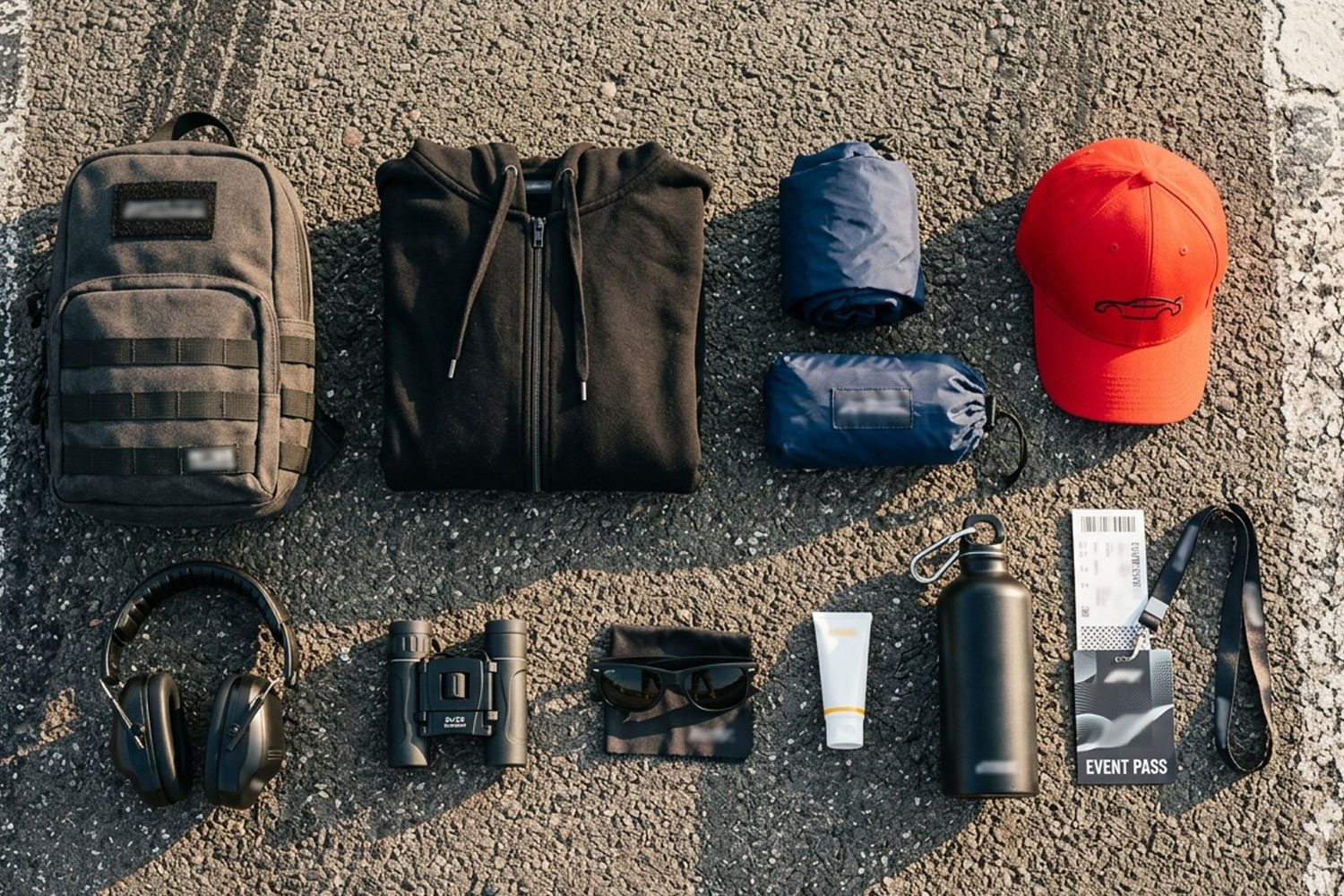
Three thousand miles from home, the sun is hammering the grandstand, the formation lap is minutes away - and you've just realized you left your earplugs at the hotel, your sunscreen is sitting on the bathroom counter, and your bag is too small to fit the jacket you now desperately need. A first Formula 1 Grand Prix can be one of the great sporting experiences of your life, but a few overlooked items can grind it down fast. This guide is a field-tested packing list built on everything from the blazing heat of Bahrain to a drenched afternoon at Spa. We'll start with the absolute non-negotiables, then work through weather scenarios and what it takes to bring a child to the circuit.
F1 Grand Prix essentials - the non-negotiable list
Certain items belong in your bag no matter which circuit, which country, or which month. Your ticket - downloaded offline or printed, because cell service near a 100,000-seat venue is notoriously patchy. A passport or government-issued ID, since VIP entry points and Paddock Club access routinely require identity checks. A power bank, because a smartphone running Bluetooth, live timing, GPS, and a camera will be dead within a few hours in direct sun.
Layer on the daily essentials: ear protection, a hat or cap, SPF 30+ sunscreen, water in a sealed plastic bottle (750 ml is the limit most circuits enforce), and a solid pair of closed-toe shoes with rubber soles. Sandals feel logical at 95 degrees, but after five miles of walking across asphalt, gravel lots, and concrete grandstand steps, you'll regret it.
Round it out with both cash and a card. Merchandise stalls, food trucks, and drink machines have wildly inconsistent payment setups at different venues. Having both options means you'll never go hungry or miss the one cap you actually wanted.
What to wear to an F1 race - layering is the rule, not the exception
Weather at a Grand Prix can turn on you even in reliably sunny countries. Monaco in May, Spa in August, Suzuka in October - all three have caught fans off guard with mid-weekend swings. The layering system solves that cleanly: a light UV-protective base layer on your body, a fleece or softshell in your pack, and you're covered for almost every scenario.
For European summer rounds in milder climates, a thin base layer and a packable wind jacket does the job. At Silverstone, Spa, or Zandvoort, plan for rain as a certainty, not a possibility. A waterproof shell with a sealed hood is not a luxury at those venues - it's infrastructure. Pants should be comfortable and ideally convertible to three-quarter length if the temperature climbs past what you expected.
A team shirt is the obvious and entirely valid starting point for any F1 fan outfit - Ferrari, McLaren, Red Bull, Mercedes - they're instantly readable from three rows away and a reliable conversation starter with whoever ends up sitting next to you.
Ear protection at F1 - this one is not optional
Hybrid-era F1 cars are quieter than they were a decade ago. They are not quiet. Sound pressure levels on the start-finish straight can top 130 dB - roughly the same as a jet engine at close range. A sore ear after a session without protection is the mild version of the outcome. Repeated exposure causes permanent hearing damage.
Three solutions exist. Disposable foam earplugs are inexpensive and effective, but they block everything - PA announcements, your neighbor, the marshal with the flag. Reusable hi-fi filtered earplugs pass speech and ambient circuit atmosphere while cutting the engine frequencies that cause damage - the preferred choice for fans who want to stay connected to their surroundings. Over-ear earmuffs deliver the strongest protection and can be connected to an FIA radio receiver, available for rent at many circuits, so you can monitor team radio directly.
For children, earmuffs are mandatory - small ears are more sensitive to noise damage, and kids frequently don't report discomfort until it's already a problem. Look for models with an SNR rating above 25 dB and an adjustable headband sized for a child's head.
Hot-weather Grand Prix - what to pack for the heat
Bahrain, Saudi Arabia, Miami, Singapore, Azerbaijan, Hungary - circuits where air temperatures routinely clear 86 degrees Fahrenheit and open grandstands offer zero shade for hours at a stretch. On top of the standard list, add: a neck gaiter or buff (sun protection and a quick cooling tool when soaked in cold water), a facial mist spray, extra fluid capacity beyond what you carried in, UV400 sunglasses, and either a cap with a brim or a wide-brimmed hat.
Apply sunscreen in the morning and reapply every two hours. You're sitting on an exposed concrete grandstand through qualifying and the race with minimal shelter - a burn on Saturday afternoon has a real chance of ruining Sunday. Light-colored, natural-fiber clothing - cotton or linen - handles heat better than synthetics. If you're a Ferrari fan committed to red, fine, but choose a lightweight technical shirt rather than a heavy cotton tee.
Wet-weather Grand Prix - preparing for a soaked race day
Spa-Francorchamps, Silverstone, Zandvoort, Suzuka - fans connect these names to spectacular circuits and also to rain that can turn into a full downpour in under fifteen minutes. A wet race is usually the best race of the season; a wet fan with no gear is just cold and miserable for three hours.
The essentials: a waterproof shell with a properly sealed hood (a wind jacket handles a light sprinkle and fails the moment it rains hard), waterproof pants or membrane-lined leggings, and closed-toe shoes with water-resistant treatment. Your backpack needs either a built-in rain cover or waterproof construction - your passport, phone, and power bank cannot get wet.
An umbrella seems like the obvious answer. Most circuits ban them in the grandstands because they block sightlines for everyone around you. A hooded rain poncho that folds into a pocket is the legal, practical alternative.
One thing people consistently forget: a dry pair of socks in the bag. Dry feet through the final two hours of a soaked race day is a wildly underrated experience.
Bringing kids to an F1 race - what the family packing list needs
Taking a child to a Grand Prix is a genuinely great idea - the colors, the speed, the noise, and the energy hit young fans just as hard as they hit adults. The preparation just needs a few additions.
Children's earmuffs lead the list - worth repeating even though it was covered above. After that: proven, broken-in shoes for the child (not sandals, not brand-new shoes fresh out of the box - something they've actually walked miles in), a small pack or hip pack for the child to carry their own water and snacks, sunscreen reapplied every two hours, and a hat. For smaller children, a soft carrier or hiking baby carrier lets you move efficiently through crowds without managing a stroller across terrain that doesn't want one.
Prepare the child mentally before race day. Explain what they're going to see, how long each session runs, where the restrooms are (lines get long), and why it's going to get extremely loud in a few minutes. Kids who know what's coming handle the sensory load of a Grand Prix considerably better than those who don't.
Choosing the right backpack for a Formula 1 Grand Prix
Your bag is the day's logistics hub. Too small, and the jacket you need for the evening session won't fit. Too large, and you're blocking your neighbor's view and getting stopped at grandstand entry. The 15-to-25-liter range hits the sweet spot - enough for a jacket, water, sunscreen, power bank, documents, food, and a souvenir, without being an obstacle.
Look for side water-bottle pockets (accessible without removing the pack), a front pocket for documents and keys, and a ventilated back panel - six hours of a pack pressed against your shirt in 90-degree heat makes its own argument. A lockable zipper or a zipper with a simple security loop is worth having; Grand Prix crowds attract pickpockets like any major event.
What NOT to bring to an F1 race
Banned items shift between circuits, but several are nearly universal. Umbrellas are prohibited in the grandstands at the vast majority of venues - they block views. Glass bottles and glass containers won't clear security anywhere. Drones and cameras with interchangeable lenses - professional SLRs or mirrorless bodies with long telephoto glass - require a press credential. A compact camera or one with a lens up to around 70-100 mm is generally fine.
Flares, smoke canisters, and torches are banned under FIA circuit regulations across the board. Megaphones won't make it through the gate at any European Grand Prix. Food in glass jars and sealed alcohol in containers over the venue's limit - also no.
The simple rule: before you leave for the event, pull up the official spectator regulations for that specific Grand Prix on the organizer's website. Rules change between seasons, and finding out in the hotel lobby is far less painful than finding out at the gate.
FAQ - questions before your first F1 race
What should I bring to my first F1 race?
The bare minimum: ticket saved offline, ID, ear protection, hat, SPF 30+ sunscreen, sealed plastic water bottle up to 750 ml, comfortable closed-toe shoes, and layered clothing matched to the forecast.
Can you bring your own food and drinks to an F1 race?
Most circuits allow sealed plastic bottles and a modest amount of food. Glass containers are banned everywhere. Check the specific Grand Prix's official regulations before you pack.
What ear protection should I wear at an F1 race?
For adults, reusable hi-fi filtered earplugs or over-ear earmuffs. For children, purpose-made earmuffs with an SNR rating above 25 dB and an adjustable headband.
What size backpack should I bring to a Formula 1 Grand Prix?
15-25 liters. It holds everything you need for a full race day, fits under or beneath a grandstand seat, and won't obstruct your neighbor's view.
What can't you bring into an F1 race?
Typically banned: umbrellas, glass containers, drones, interchangeable-lens cameras without press credentials, flares, smoke canisters, torches, and megaphones. The full list is always in the event organizer's official spectator regulations.