
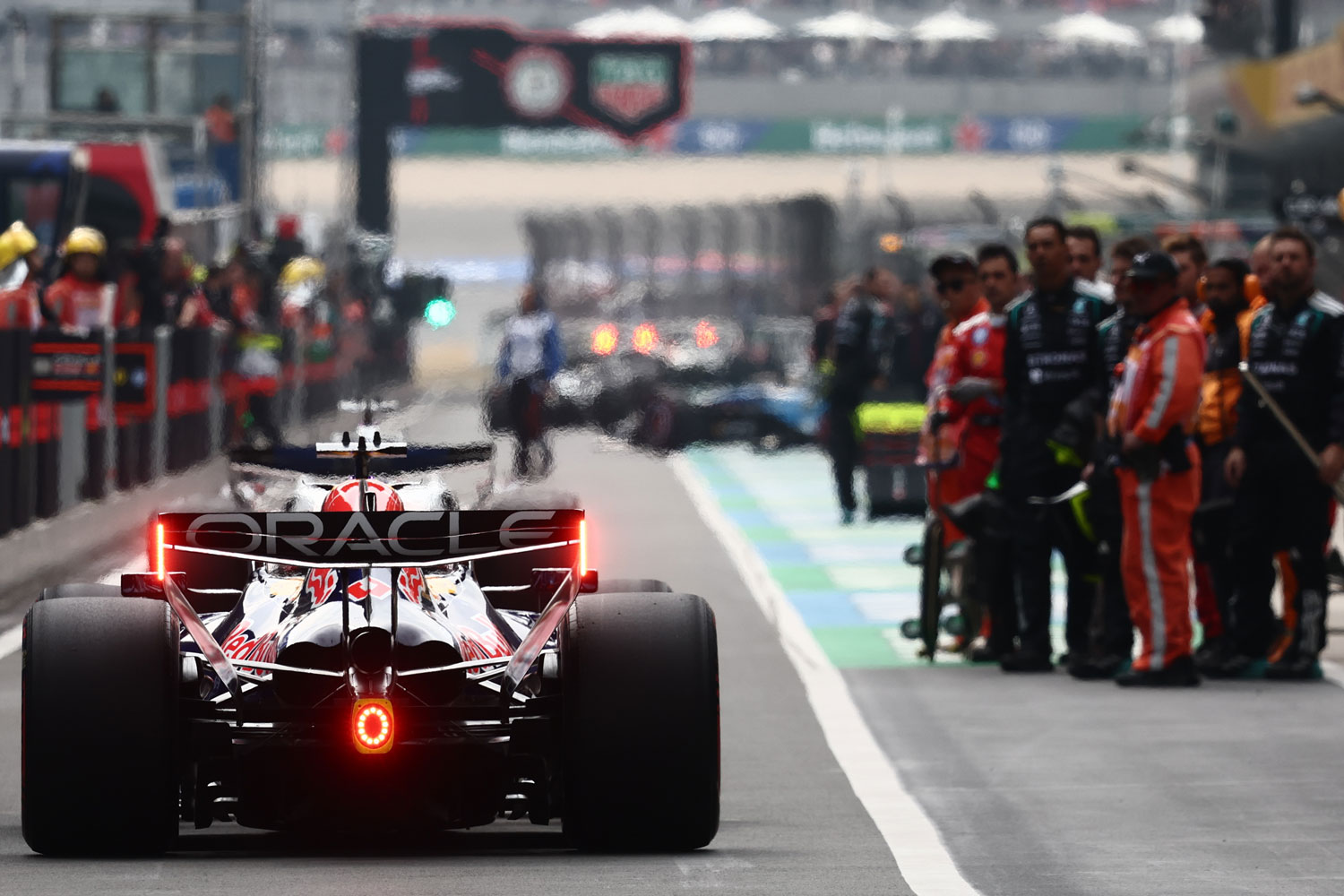
After qualifying at Spa, Oscar Piastri said something you don't expect to hear from a Formula 1 driver: that the grid order was, in large part, decided by artificial intelligence. That wasn't frustration talking - it was an apparently accurate diagnosis of what the 2026 season has become technically. The new-generation power units carry self-learning algorithms that can catch a driver off guard just as badly as they catch the engineer staring at the monitor. Where does this behavior come from, how much can a driver actually do about it, and is there a fix on the horizon? Those are the questions this article sets out to answer.
How self-learning algorithms work in F1 2026 power units
When Andrea Stella was walking through debrief notes at Spa, the words he reached for were "random" and "difficult to capture in modeling." That's telling - the technical chief of the championship-leading team is saying his engineers don't always know why the engine did what it did. So what's actually going on?
The F1 2026 power units contain predictive systems that learn on the fly. The algorithm processes data from previous laps - speed at individual points around the circuit, engine load, energy consumed and recovered - and uses it to project the optimal electric energy deployment strategy for the next lap. This isn't artificial intelligence in the everyday sense. It's a sophisticated adaptive system that constantly revises its own assumptions.
That learning doesn't only happen between laps. If a deviation from the expected pattern appears mid-lap, the algorithm immediately recalculates the optimal way to distribute the remaining energy for the rest of the tour. On paper that sounds like a feature. The problem starts when real-world conditions diverge from the training environment in which the model was built.
Why Hadjar couldn't hold position behind Verstappen
The most vivid example from Belgium came courtesy of Isack Hadjar. The Frenchman wanted to give Max Verstappen a tow, so he drifted wide on the exit of Turn 14 and waited for the world champion to come through. The trouble was that stopping in a random spot on track wasn't anywhere in the energy deployment script.
The algorithm read a signal it wasn't built for: the car is stationary where it shouldn't be. The system got "confused" - Hadjar's own word - and when he got back on the throttle it responded in a way he had no reason to anticipate. On the first attempt he had far too much power and pulled away from Verstappen instead of sitting ahead of him. On the second he had too little, Red Bull started closing, and the tow never materialized.
That's an extreme case, but the same mechanism fires on much smaller deviations. A slightly early or late lift, a corner entry a touch faster or slower than the lap before - all of it feeds the algorithm fresh data and can shift power unit behavior in a direction the driver never saw coming.
How much depends on the driver - and what falls completely outside his control
Lando Norris put it plainly: with these energy swings, "it's not about you as a driver." That's true, but only up to a point.
Some variables do sit with the driver. If he lifts off the throttle too late at a specific location, or crosses roughly 60 percent throttle opening too early on a corner exit, the energy balance shifts. The algorithm logs it and adjusts its strategy for the remainder of the lap. That's precisely why Norris said earlier in the season that drivers can no longer make a difference through bravery, only through the kind of metronomic precision the power unit demands. George Russell arrived at Spa having reworked his driving style after Mercedes flagged that his inputs might be contributing to the straight-line deficit. The deficit showed up in Belgium anyway.
The reason is that the second half of the equation is entirely beyond anyone in the cockpit. Stella identified two key external factors: track grip and wind. A stronger headwind makes the algorithm "think" the straight is longer than it is - because the car bleeds speed before it reaches the end - and the system adjusts energy deployment to match that false reading. The result is a power hole exactly where the driver needs the most thrust.
"The algorithm is sensitive to external parameters," Stella said. "If you have more headwind, the straight takes longer, and that is a parameter you cannot fully replicate in modeling because it has a somewhat random character."
How energy swings translate to lap time and race strategy
Unpredictable electric energy deployment hits drivers in two distinct ways. The first is straightforward time loss on the straights - the kind that left Piastri several tenths down on Norris in Saturday qualifying at Spa despite the two being effectively identical through the corners. The second is subtler but equally damaging.
Stella explained that energy swings affect braking markers. If the power unit recovers more energy than usual on the approach to a braking zone, the car is carrying several km/h less speed at the point where the driver begins to stop - and the braking marker has to move. If the driver doesn't know that extra regeneration is coming, he brakes too late. Or, if he's braced for strong regeneration that doesn't arrive, he brakes too early and gives time away.
"It's quite difficult to manage for the drivers," Stella said. "Not only because it affects the limited-power sections, but also because the power unit variations change the reference points on the approach to a corner."
For a driver that means constantly adapting to an engine that is itself constantly adapting. It's a feedback loop of uncertainty that - as the drivers themselves acknowledge - is simply an unappealing way to compete.
Is there a solution, and how soon can anyone expect it
The good news is that the problem is clearly circuit-specific. Spa is an enormous energy circuit - long straights where electric power is the difference-maker. The Hungaroring and Zandvoort are different animals: shorter straights, heavier corner content, less pressure on energy management. At those venues drivers and engineers get a bit of breathing room.
The bad news is there's no quick fix. Stella admitted outright that after Belgium his team still didn't fully understand why the electric energy had been deployed differently than planned. Credit to him - that kind of candor is rare in the F1 paddock. McLaren also confirmed that just before the Belgian weekend it had finally received a simulation toolset from Mercedes HPP that it had been requesting for some time. That's progress, but the gap between having the tools and genuinely understanding the system's behavior is still a long road.
"I think we are still a bit too far away - let's say a few races - from a full understanding of the power unit behavior and its exploitation," Stella said after leaving Belgium.
Significant regulatory changes governing the power split between the combustion and electric sides of the unit are set to be phased in during 2028. In theory that reduces the role of electric energy and could soften the problem. Piastri is skeptical. His view is that the issue isn't in the proportions but in how the engine is calibrated and how it learns. Those characteristics are, in his assessment, written into the DNA of the current rules, and shifting the power ratio won't erase them.
What this means for F1 fans watching in 2026
From a fan's perspective, the 2026 season is a massive technical experiment with an unexpected side effect. The new regulations were supposed to deliver exciting racing and reshuffled pecking orders. On both counts they delivered - the championship fight is tight, and multiple teams can realistically target wins. But buried inside all of that is something nobody signed up for: randomness.
When Piastri talks about "the computers doing stupid things," and Norris acknowledges that a qualifying result can hinge on whether your engine happened to behave that lap, that's an admission which says a lot about the nature of the current competition. The best driver in the world won't always outpace an average one if that average driver catches a lap where his car's algorithm runs perfectly and the champion's doesn't.
There's also a practical dimension for anyone tracking the championship standings. Points lost and gained through factors that are essentially "random" - Stella's own word - will make results harder to read all season. When someone drops three grid positions in qualifying because wind fooled the algorithm, does that result reflect the car's actual pace? Not entirely. And that's exactly the debate that started at Spa and won't be over until the checkered flag falls on the final race of the year.
If you want to follow all of it live, every session of the 2026 Formula 1 season - practice, qualifying and race - streams exclusively on Apple TV, with an F1 TV Premium subscription included at no extra cost.
FAQ - F1 2026 AI power units, your questions answered
Is the AI in F1 2026 power units the same kind of AI as ChatGPT?
No. These are advanced predictive algorithms and adaptive systems that optimize electric energy deployment based on data from previous laps. They have nothing to do with generative AI or deep learning in the popular sense.
Can a driver prevent unpredictable power unit behavior?
Some factors are within the driver's control - throttle timing and corner precision, for instance. But external parameters like wind and track grip are completely outside anyone's control and still feed the algorithm.
At which circuits is the problem most pronounced?
On long, high-speed straights where electric power plays a decisive role - Spa-Francorchamps is the textbook example. Shorter, twistier layouts like the Hungaroring place far less demand on energy management.
Will the 2028 regulation changes fix this problem?
According to Oscar Piastri - only partially. A two-stage shift in the power split between combustion and electric will reduce the role of energy deployment somewhat, but it won't eliminate the calibration and learning-logic issues in the current architecture.
When will teams fully understand their power units?
McLaren's Andrea Stella said after Belgium that teams are still a few races away from full understanding. Manufacturers are gradually releasing simulation tools designed to help predict system behavior.